
Why Practice Self-Awareness for True Inner Growth

Self-awareness seems simple on the surface, but its true depth often eludes even the most thoughtful creators. For anyone navigating high-pressure environments in cities like New York, London, or Tokyo, understanding your mind and emotions becomes a powerful tool for real growth. Recent research shows self-awareness is not a single skill but a collection of abilities—like tracking emotional triggers, noticing physical sensations, and observing the gap between impulse and choice—that reshape how you relate to yourself and the world.
Table of Contents
Key Takeaways
Point | Details |
Self-Awareness is Multifaceted | It involves understanding your emotions, beliefs, and patterns of behavior, which allows for personal growth across various contexts. |
Meditation Enhances Self-Awareness | Regular meditation strengthens attention regulation and present-moment awareness, facilitating objective self-observation. |
Avoid Common Myths | Embrace self-awareness as a continuous journey rather than a fixed destination, and recognize that introspection should be balanced, not excessive. |
Feedback is Vital | External perspectives from trusted individuals can reveal blind spots and enhance your understanding, ensuring a more accurate self-assessment. |
Defining Self-Awareness and Common Myths
Self-awareness sounds simple, but it’s surprisingly complex. It’s not just knowing your name or recognizing yourself in a mirror. Self-awareness involves understanding your internal states, emotional patterns, beliefs, and how others perceive you in ways that directly shape your growth trajectory.
Research reveals self-awareness as multifaceted, encompassing your beliefs, mental states, physical sensations, traits, motivations, and behaviors. It’s not a single switch you flip. Instead, it operates across different contexts, shifting depending on whether you’re at work, in relationships, or alone with your thoughts.
What Self-Awareness Actually Means
At its core, self-awareness is the ability to observe yourself without judgment. You notice when anxiety tightens in your chest. You catch yourself spiraling into negative self-talk. You recognize patterns in how you react to pressure or criticism.
This includes:
Recognizing your emotional triggers and how they influence decisions
Understanding your core values and whether your actions align with them
Noticing physical sensations tied to emotional states
Observing how your behavior affects those around you
Identifying gaps between who you think you are and who you actually are
Unlike self-consciousness (feeling awkward or embarrassed), self-awareness is neutral observation. You’re not judging yourself. You’re simply seeing clearly.
Self-awareness develops through introspection, self-evaluation, and honest feedback—it’s a learnable skill, not an innate talent you either have or lack.
Myths That Block Your Progress
Myth #1: Self-Awareness Means Thinking About Yourself Constantly
Wrong. Constant self-analysis often traps you in your own mind, creating anxiety rather than clarity. True self-awareness happens through quiet observation during meditation or journaling—not endless rumination.
Myth #2: You’ll Figure Yourself Out Once and For All
Self-awareness isn’t a destination. You evolve. Your triggers shift. Your values mature. What worked for you at 25 may feel misaligned at 35. The practice is continuous, not a one-time achievement.
Myth #3: Introspection Alone Gives You Complete Self-Knowledge
Your internal perspective has blind spots. Introspection can sometimes yield flawed knowledge or reinforce limiting beliefs. External feedback from trusted people completes the picture.
Myth #4: Self-Aware People Don’t Have Emotional Struggles
Actually, the opposite is true. Self-aware people feel their emotions fully—they just don’t let emotions control their decisions. They acknowledge the struggle rather than pretending it doesn’t exist.
Myth #5: You Need Therapy to Build Self-Awareness
Therapy helps. So do meditation, journaling, honest conversations, and creative work. Self-awareness practices exist everywhere—you get to choose what resonates with your life.
Understanding these myths clears the confusion that blocks many people from starting this practice. You’re not aiming for perfection or constant self-reflection. You’re building the capacity to see yourself clearly enough to make aligned choices.
Pro tip: Start with one micro-practice this week—notice one emotional trigger when it happens, pause, and ask yourself what’s underneath it. This single act builds momentum toward genuine self-awareness.
How Meditation Deepens Self-Awareness
Meditation isn’t just about feeling calm. It’s one of the most direct pathways to seeing yourself clearly. When you sit quietly and observe your thoughts without judgment, you’re actively building the neural pathways that support self-awareness.
The connection is straightforward: meditation trains your attention. As you focus on your breath or bodily sensations, you’re practicing the exact skill self-awareness requires—noticing what’s happening inside you without getting swept away by it.
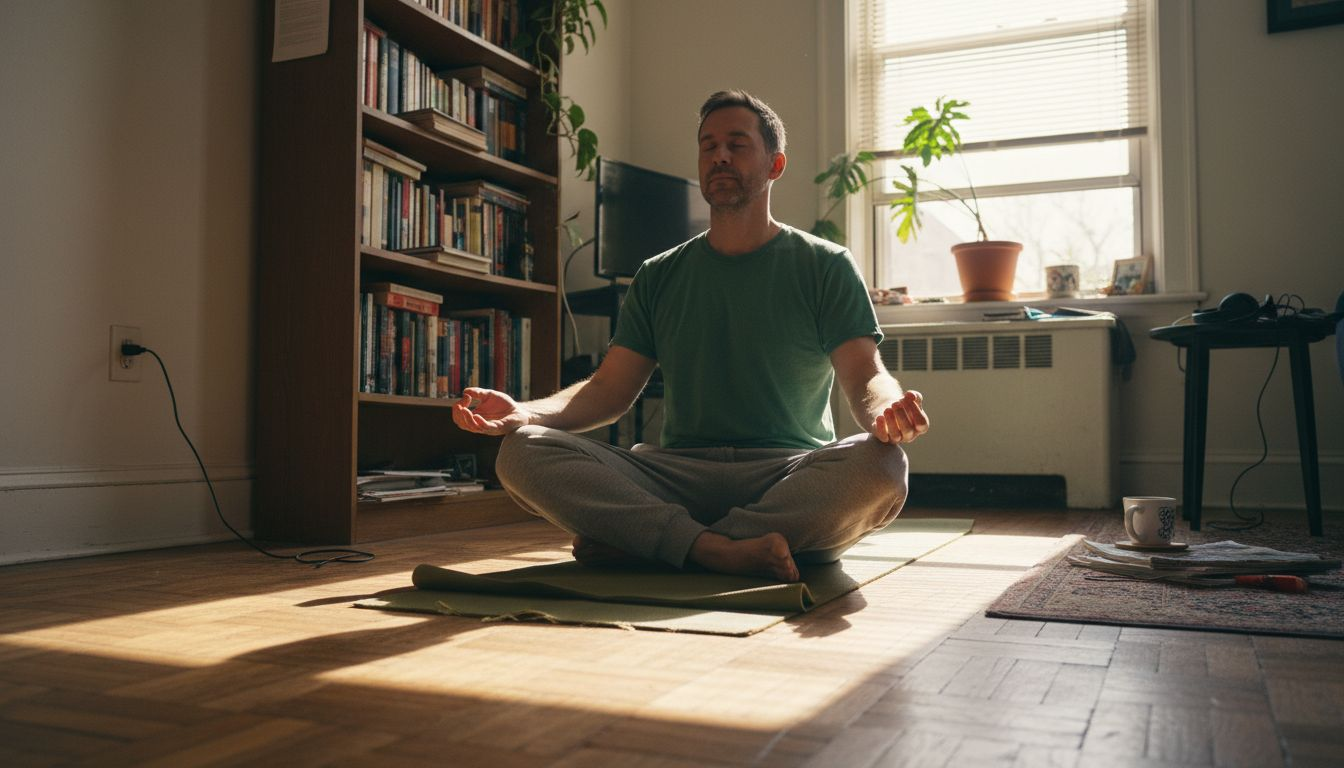
The Mechanism: How Meditation Works
When you meditate, two things happen simultaneously. First, you strengthen attention regulation—your ability to direct focus where you want it. Second, you develop present-moment awareness, which is the foundation of self-awareness.
Meditation practices like focused attention and open-monitoring naturally increase mindfulness and self-awareness by anchoring you in the now rather than lost in thought patterns. You begin noticing:
Physical sensations you normally ignore
Emotional patterns before they escalate
Thought loops that recycle repeatedly
Your automatic reactions to discomfort
The gap between impulse and choice
Research shows meditation increases cortical thickness in brain regions linked to emotional regulation and self-awareness. These structural changes translate directly to better emotional control and stress resilience in daily life.
Experienced meditators demonstrate higher introspective interest and mindfulness skills—they literally know themselves better than non-meditators because their practice rewires how their brains process self-awareness.
Why This Matters for Your Growth
Without meditation, self-awareness stays intellectual. You can read about your triggers, but you don’t feel them shifting. Meditation creates experiential awareness—you actually witness your patterns changing in real time.
This is where true inner growth happens. You’re not analyzing yourself from a distance. You’re actively observing and, through that observation, naturally releasing old patterns.
The benefits compound:
You notice triggers earlier (before reacting)
You respond with more choices instead of autopilot reactions
You understand your emotional needs more clearly
You catch self-sabotaging beliefs before they take root
You develop compassion for your own struggles
Even 10 minutes daily creates measurable shifts in self-awareness within weeks. The consistency matters more than duration—a brief practice you actually do beats an ambitious routine you abandon.
Clarity through meditation happens when you combine consistent practice with genuine curiosity about what you’re observing. You’re not meditating to fix yourself. You’re meditating to know yourself.
Pro tip: After your meditation, spend 2 minutes journaling what you noticed—one physical sensation, one emotion, one thought pattern. This simple step anchors self-awareness from meditation into lasting insight.
Brain and Emotional Benefits of Self-Awareness
Self-awareness isn’t a soft skill—it rewires your brain. When you develop the ability to observe yourself, you’re activating neural networks that fundamentally change how you process emotions, make decisions, and handle stress.
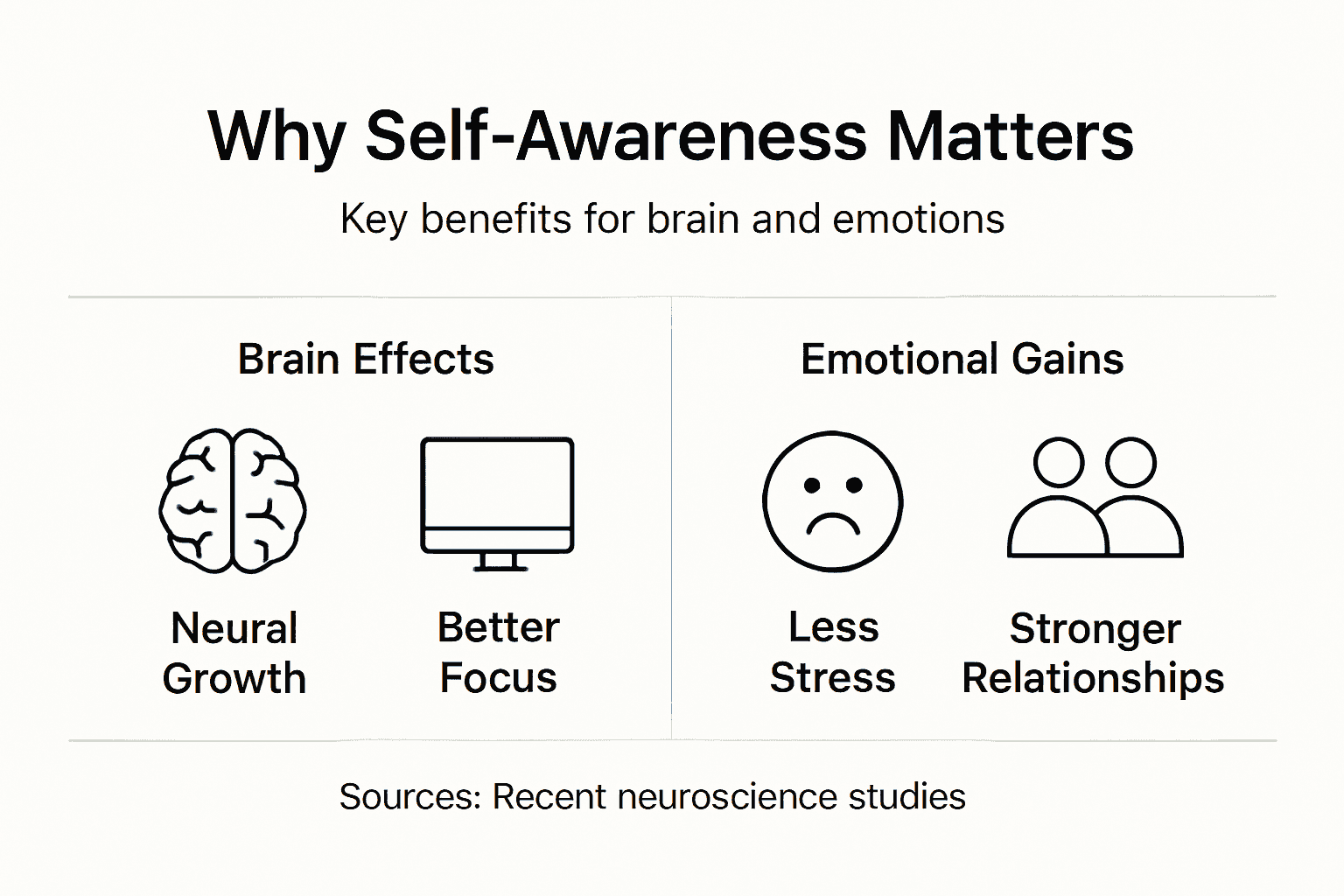
Your brain contains intricate systems dedicated to self-awareness. These systems integrate information about your body, your emotions, your past experiences, and your current moment. The stronger these connections, the more resilient and emotionally intelligent you become.
How Self-Awareness Transforms Your Brain
Self-awareness engages multiple cognitive and neural processes that work together to support emotional regulation and conscious choice. Your brain doesn’t just think about emotions—it processes them through interconnected pathways.
When you practice self-awareness, you strengthen:
The anterior cingulate cortex (emotional processing and attention)
The prefrontal cortex (decision-making and impulse control)
The insula (bodily sensation awareness and emotional clarity)
Connections between emotional and rational brain regions
These structural changes mean your brain literally becomes better at managing emotions and handling stress. You’re not just thinking differently—your neural architecture is reorganizing itself.
Emotional regulation and resilience develop naturally when self-awareness becomes your foundation, enabling you to recognize triggers before reacting.
The Emotional Intelligence Connection
Self-awareness is where emotional intelligence begins. It’s the difference between being swept away by anger and noticing the anger while choosing your response.
When you’re self-aware, you:
Recognize emotional triggers before they control you
Understand what you actually need in moments of stress
Regulate your nervous system instead of defaulting to fight-or-flight
Make decisions from clarity rather than reactivity
Build stronger relationships through genuine understanding of your patterns
This isn’t theoretical. Self-aware individuals experience measurably lower stress, better sleep, improved relationships, and greater overall well-being. Your emotions don’t disappear—you just stop being their puppet.
Real-World Impact
Consider a creative professional facing criticism on a project. Without self-awareness, that feedback triggers defensiveness. With self-awareness, you notice the defensive impulse, pause, and extract the useful information.
That single pause—that space between impulse and action—is where your brain’s emotional processing catches up with your thinking. Self-awareness develops the ability to observe yourself objectively, creating the psychological distance needed for wise choice.
Over time, these pauses become automatic. Your brain rewires itself through repetition. You become someone who responds rather than reacts.
The compounding benefits are substantial: reduced anxiety, improved focus, better sleep, deeper relationships, and actual career advancement. All starting with the simple practice of noticing what’s happening inside you.
Pro tip: When strong emotion arises, pause and ask: “What physical sensation am I experiencing?” This single question activates your self-awareness network and shifts you from reactive to responsive.
Potential Pitfalls and How to Avoid Them
Self-awareness is powerful, but it’s not foolproof. Without proper understanding, you can slip into traps that actually undermine your growth. The good news? These pitfalls are entirely avoidable once you know what to watch for.
Many people confuse self-awareness with self-consciousness or endless self-analysis. That’s not the same thing. Real self-awareness is clear observation without judgment, not constant rumination about your flaws.
The Self-Reflection Trap
Too much introspection can backfire. When you spend hours analyzing why you made a mistake, you’re not building self-awareness—you’re feeding anxiety and self-doubt.
Excessive introspection may increase negative emotions related to inadequacy, creating a spiral of self-criticism instead of growth. The key is balance—observe yourself, then move forward.
Common traps include:
Spiraling into analysis paralysis
Mistaking rumination for insight
Focusing only on what’s “wrong” with you
Using self-awareness as a weapon against yourself
Confusing self-awareness with perfectionism
Stop turning self-awareness into self-punishment. The goal is to understand yourself, not condemn yourself.
Bias in Self-Assessment
Your self-perception isn’t always accurate. You might overestimate your strengths (self-enhancement bias) or underestimate them if you’re struggling. Self-assessment can be biased, creating distorted self-views that don’t match reality.
This is why external feedback matters. A trusted friend, mentor, or coach sees things you miss. They notice patterns you’ve normalized. They offer perspective your internal view can’t provide.
How to stay grounded:
Seek feedback from people who know you well and care about your growth
Notice where your self-perception conflicts with feedback—that’s where blind spots hide
Test your self-beliefs against actual evidence from your life
Avoid rigid self-judgments (“I’m bad at X”) in favor of flexible observation (“I struggle with X sometimes”)
Remember that your view of yourself changes based on your emotional state
The Conceptual Confusion
Self-awareness gets tangled with self-consciousness and self-knowledge, but they’re different. Self-consciousness is feeling uncomfortable or awkward. Self-knowledge is factual information about yourself. Self-awareness is the active capacity to observe yourself in real time.
Clarity about these distinctions protects you from confusing feeling embarrassed with being self-aware. You can be painfully self-conscious without any actual self-awareness.
Here’s a clear comparison of self-awareness, self-consciousness, and self-knowledge to help distinguish their roles:
Concept | Main Focus | Emotional Impact | Practical Use |
Self-Awareness | Real-time observation | Neutral, nonjudgmental | Guides growth and decisions |
Self-Consciousness | Concern over others’ views | Anxiety or embarrassment | May hinder authentic action |
Self-Knowledge | Facts about oneself | None, factual | Informs choices and identity |
Practical Prevention
The antidote to pitfalls is structured, balanced practice. You’re not aiming for constant introspection. You’re building moments of clear observation throughout your day.
Think of it like brushing your teeth—consistent, brief practices work better than occasional intensive sessions. A few minutes of genuine self-observation beats hours of anxious rumination.
Pro tip: Set a timer for 5 minutes of self-reflection, then stop. This prevents the introspection spiral while building the skill of clear observation without judgment.
Practical Tools to Sustain Growth Daily
Self-awareness isn’t built through occasional insight—it’s sustained through consistent practice. The tools that work are simple, repeatable, and designed to fit into your real life without adding stress.
You don’t need elaborate systems. You need practices that stick because they’re small enough to do every single day, even on chaotic mornings.
Journaling: The Foundation Practice
Reflective journaling promotes deeper self-reflection by encouraging systematic analysis of experiences, emotions, and behaviors. This isn’t about polished writing. It’s unfiltered observation on paper.
Effective journaling asks:
What triggered my strongest emotion today?
Where did I react instead of respond?
What pattern did I notice repeating?
What am I avoiding looking at?
What felt aligned with my values today?
Even 5-10 minutes daily creates momentum. You’ll notice patterns emerge after just two weeks. Your subconscious reveals itself through writing in ways it never does through thinking alone.
Journaling transforms vague feelings into specific insights. What seemed confusing becomes clear once you write it down.
Meditation and Mindfulness Practice
Mindfulness-based practices anchor self-awareness in real time. Rather than analyzing yourself after the fact, you’re observing what’s happening as it happens.
Start with simple techniques:
Body scan meditation (notice physical sensations for 5 minutes)
Breath awareness (follow your breath without controlling it)
Emotion labeling (name emotions as they arise, without judgment)
Sensory grounding (notice five things you see, four you hear, three you feel)
These aren’t complex. They’re designed to quiet your analytical mind and activate your observational capacity. Consistency matters more than duration—daily practice beats occasional long sessions.
Emotional Regulation Strategies
Emotional regulation strategies, including cognitive reappraisal and feedback mechanisms, mediate improved decision-making and personal growth. This means naming what you feel, understanding why, and choosing your response intentionally.
When strong emotion arises, try this framework:
Pause (literally stop for three seconds)
Name the emotion specifically (not just “upset,” but “frustrated” or “scared”)
Notice the physical sensation tied to it
Ask what you actually need in this moment
Choose one conscious action instead of defaulting to automatic reaction
This single practice, repeated daily, rewires how you handle difficult moments. You’re building the gap between stimulus and response—that’s where freedom lives.
External Feedback and Accountability
Asking for feedback feels vulnerable, but it’s essential. Your self-perception has blind spots. A trusted person (friend, coach, mentor) sees things you miss.
Make it easy by asking specific questions:
“What pattern do you notice in how I handle conflict?”
“When do I seem most engaged and alive?”
“Where do you see me holding myself back?”
Then actually listen without defending. The discomfort you feel when hearing feedback is valuable data—it shows where your self-image doesn’t match reality.
Below is a summary of daily practices for sustaining self-awareness and their unique advantages:
Practice | Key Benefit | Best For | Time Commitment |
Reflective Journaling | Turns feelings into insight | Pattern recognition | 5-10 minutes daily |
Meditation | Builds awareness of patterns | Emotional regulation | 5-10 minutes daily |
External Feedback | Reveals blind spots | Balanced self-view | As needed, regular check-ins |
Pro tip: Combine journaling (3 minutes), meditation (5 minutes), and one emotion regulation practice (2 minutes) into a 10-minute morning routine that compounds exponentially over weeks.
Unlock Your True Inner Growth Through Deepened Self-Awareness
The journey to genuine self-awareness is not only about understanding your emotions and thought patterns but also about embodying practices that sustain lasting transformation. If you have felt stuck in endless rumination or uncertain how to move beyond intellectual insight toward real experiential change, the challenge lies in integrating meditation, mindful journaling, and energetic alignment into daily life. This article highlights how meditation rewires your brain for emotional regulation and self-observation and reveals common pitfalls like excessive introspection and biased self-assessment. If your goal is to break free from these traps and develop consistent, clear, and compassionate self-awareness, the solution is at your fingertips.

Awaken Flow Mastery offers a comprehensive 30-day guided meditation program that marries meditation with intuitive journaling and sound frequencies to deepen your connection with your energetic field and higher self. This program is designed specifically to help you cultivate the very self-awareness described here with practical, experiential tools rooted in over a decade of energy work expertise. By participating, you receive not just techniques but a supportive structure to embed your insights into real life effortlessly. Start transforming stress and scattered emotions into clarity, resilience, and flow states today. Explore how effortlessly sustained self-awareness fosters true inner growth at Awaken Flow Mastery. You deserve a growth process that works with your energy and your life, not against it.
Take the step now to experience the power of meditation and mindful journaling combined by visiting our 30-day guided meditation series and start your path to aligned, lasting transformation.
Frequently Asked Questions
What is self-awareness and why is it important for personal growth?
Self-awareness is the ability to understand your internal states, emotional patterns, beliefs, and how others perceive you. It is crucial for personal growth as it enables you to recognize emotional triggers, align actions with core values, and observe how your behavior impacts others.
How can meditation enhance self-awareness?
Meditation helps improve self-awareness by training attention and present-moment awareness. Through practices like focused attention, you learn to observe thoughts and emotions without judgment, leading to deeper insight into your emotional patterns and behaviors.
What common myths about self-awareness should I be aware of?
Some common myths include the belief that self-awareness means constant self-analysis, that it is a one-time achievement, or that self-aware individuals don’t struggle with emotions. Understanding these myths can help you approach self-awareness with realistic expectations.
What practical tools can I use daily to build self-awareness?
Effective daily practices for building self-awareness include reflective journaling, meditation, emotional regulation strategies, and seeking external feedback. Each practice promotes clearer observation of your thoughts and feelings, helping you understand yourself better.
Recommended

Comments