
What is meditation integration? A 2026 guide to daily practice

Most people believe meditation ends when the timer goes off, but that’s exactly where the real transformation begins. Meditation integration is the practice of carrying mindful awareness beyond your cushion into every moment of your day. It transforms meditation from an isolated activity into a continuous lifestyle that enhances emotional balance, deepens self-awareness, and accelerates spiritual growth. This guide explains what meditation integration truly means, why it matters for your well-being, and how to weave it seamlessly into your daily routines using practical strategies and guided support.
Table of Contents
Key takeaways
Point | Details |
Meditation integration applies insights continuously | It extends meditation benefits throughout your day, not just during formal sessions |
Enhances emotional balance and self-awareness | Regular integration reduces stress and improves overall well-being naturally |
Practical strategies make integration accessible | Mindful transitions and reflection help embed meditation into everyday life |
Guided sessions accelerate integration success | Structured programs with supportive resources build consistent, effective habits |
Understanding meditation integration: beyond the cushion
Meditation integration is the continual incorporation of meditation awareness into your daily routines, decisions, and interactions. Unlike traditional meditation confined to scheduled sessions, integration means carrying that clarity and presence into every activity. You maintain mindful awareness while cooking breakfast, responding to emails, or having difficult conversations. This approach transforms meditation from something you do into something you are.
The benefits extend far beyond stress reduction. Meditation integration extends the benefits of mindful awareness into daily life activities, enhancing emotional regulation and self-awareness in real time. You develop the capacity to notice reactive patterns as they arise, choose responses instead of defaulting to habits, and maintain inner calm amid external chaos. Your emotional resilience strengthens because you’re practicing awareness continuously rather than in isolated 20-minute windows.
Consistent awareness during transitions between activities forms the foundation of effective integration. The moment you close your laptop and stand up, the pause before answering your phone, the breath you take before entering a meeting—these micro-moments become opportunities for presence. Integration enables meditation to influence your overall lifestyle positively, shaping how you relate to yourself, others, and challenges.
Pro Tip: Begin small by setting a single meditation intention for one daily activity, like mindful dishwashing or conscious commuting, then gradually expand integration to additional routines as the practice becomes natural.
Core meditation techniques supporting integration
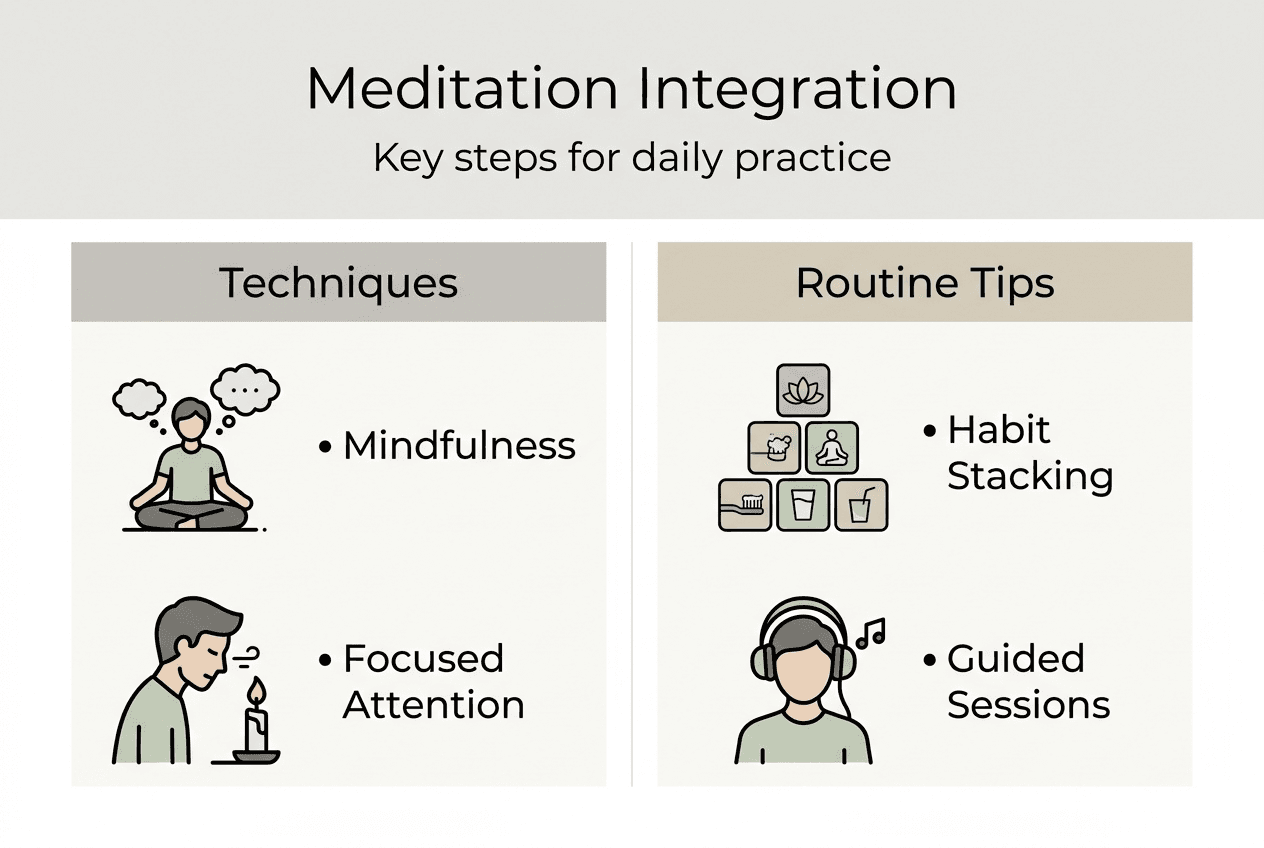
Different meditation practices support integration in distinct ways, each offering unique pathways to emotional balance and spiritual growth. The four primary techniques include mindfulness meditation, focused attention, loving-kindness, and guided visualization. Understanding how each method facilitates integration helps you select practices aligned with your lifestyle and goals.
Mindfulness meditation promotes ongoing present-moment awareness, making it ideal for daily integration. You learn to observe thoughts, sensations, and emotions without judgment, a skill that translates directly into navigating daily life with greater clarity. Different meditation practices support integration differently, with mindfulness meditation helping reduce stress by 40% through consistent present-moment focus. This technique becomes second nature with practice, allowing you to maintain awareness while performing routine tasks.

Focused attention meditation trains concentration by directing awareness to a single object, like breath or a mantra. This strengthens your ability to stay present during complex activities and resist distractions. Loving-kindness meditation cultivates compassion and emotional warmth, transforming how you respond to challenging people and situations throughout your day. Guided visualization uses imagery to access deeper states of consciousness, supporting spiritual awakening and creative problem-solving in daily contexts.
| Technique | Complexity | Primary Benefits | Best Integration Contexts | | — | — | — | | Mindfulness | Beginner-friendly | Present-moment awareness, stress reduction | Routine tasks, transitions, emotional regulation | | Focused Attention | Moderate | Concentration, mental clarity | Complex work, learning, decision-making | | Loving-Kindness | Beginner-friendly | Compassion, emotional warmth | Relationships, conflict, self-compassion | | Guided Visualization | Moderate-advanced | Spiritual insight, creativity | Problem-solving, goal-setting, healing |
Choosing and adapting techniques to your personal lifestyle requires experimentation and honest self-assessment. Consider these factors:
Match technique complexity to your current experience level to avoid frustration
Select practices addressing your specific goals, whether stress management or spiritual growth
Experiment with types of meditation practices for personal growth to discover what resonates
Adapt formal techniques into informal moments, like practicing loving-kindness while waiting in line
Combine multiple approaches for comprehensive integration support
The key is practicing techniques during both formal sessions and informal moments, creating a continuous thread of awareness throughout your day.
Applying meditation integration in daily routines
Transforming meditation from theory into lived experience requires concrete strategies embedded into your existing schedule. The goal is making integration so natural it becomes invisible, woven seamlessly into how you move through your day.
Mindful transitions between activities serve as powerful integration anchors. When you finish one task and begin another, pause for three conscious breaths. Notice the shift in your body, acknowledge any lingering thoughts from the previous activity, and set a brief intention for what comes next. This simple practice prevents autopilot mode and maintains present-moment awareness across your day. Breath awareness during routine activities like walking, eating, or showering keeps you grounded without requiring extra time. Emotional check-ins at scheduled intervals help you notice stress building before it becomes overwhelming.
Daily mindfulness practices offer effective stress relief, especially for beginners integrating meditation into life through consistent, accessible techniques. The key is starting small and building gradually rather than attempting dramatic overnight changes that rarely stick.
A simple daily meditation integration schedule looks like this:
Morning: Five-minute formal meditation upon waking to set your intention for the day
Commute: Practice breath awareness or body scanning during travel time
Mid-morning: Take three conscious breaths before starting major tasks or meetings
Lunch: Eat one meal mindfully each day, noticing flavors, textures, and sensations
Afternoon: Set a reminder for a two-minute breathing break every two hours
Evening transition: Pause when arriving home to consciously shift from work mode to personal time
Before bed: Reflect briefly on moments of presence throughout the day
Guided meditation sessions and supportive digital resources accelerate habit formation by providing structure, accountability, and expert guidance. A daily mindfulness practice guide offers frameworks for building sustainable integration routines tailored to your schedule and goals.
Pro Tip: Use habit stacking by attaching meditation integration to existing routines, like taking three conscious breaths every time you pour coffee or checking your breath before opening email, creating automatic triggers that maintain momentum throughout busy days.
Measuring progress and deepening your meditation integration
Recognizing the signs of effective meditation integration helps you stay motivated and adjust your approach as needed. Unlike formal meditation where progress might feel abstract, integration produces tangible changes in how you experience daily life.
Improved focus manifests as the ability to complete tasks with fewer distractions and greater efficiency. You notice when your mind wanders and gently redirect attention without self-criticism. Emotional resilience shows up as remaining calm during situations that previously triggered stress or reactivity. You develop space between stimulus and response, choosing how to engage rather than reacting automatically. Clarity emerges as better decision-making, clearer communication, and reduced mental fog.
Self-reflection questions for assessing integration progress and challenges include:
How often do I catch myself operating on autopilot versus being present?
Which daily activities feel most conducive to maintaining awareness?
What triggers cause me to lose presence, and how quickly do I recover?
Am I noticing emotions earlier, before they escalate into overwhelm?
How has my relationship with stress and difficulty shifted?
Simple journaling or tracking methods provide objective data about your integration journey. Spend two minutes each evening noting moments of presence, challenges encountered, and insights gained. Rate your overall awareness level for the day on a scale of one to ten. Track specific metrics like reaction time to stress, quality of sleep, or relationship satisfaction. These records reveal patterns and progress that might otherwise go unnoticed.
Stage | Typical Experience | Duration | Recommended Response |
Beginning | Frequent forgetting, requires effort | 2-4 weeks | Use multiple reminders, celebrate small wins |
Developing | Inconsistent awareness, some naturalness | 2-3 months | Deepen practice, explore new techniques |
Established | Regular presence, occasional lapses | 4-6 months | Refine approach, address resistance |
Advanced | Sustained awareness, effortless flow | 6+ months | Teach others, explore advanced practices |
Meditation integration positively impacts productivity and self-awareness, as supported by recent studies showing measurable improvements in focus and emotional regulation. These benefits compound over time, making consistent practice increasingly rewarding.
Deepening integration requires ongoing adaptation based on personal experience and reflection. Join communities of practitioners to share insights and maintain motivation. Explore advanced techniques like open awareness or energy work when foundational practices become second nature. Participate in guided challenges that push your integration skills into new domains. The journey never truly ends because each life phase presents fresh opportunities for bringing meditation into new contexts and relationships.
Discover guided meditation and support at Awaken Flow Mastery
Transforming your meditation integration journey from concept to reality becomes significantly easier with expert guidance and structured support. Awaken Flow Mastery offers a comprehensive 30-day guided meditation series specifically designed for seamless integration into daily life. Each session combines meditation instruction with practical integration strategies, helping you build sustainable habits that extend benefits throughout your day.
The program includes intuitive journaling prompts, sound frequencies for deeper states, and a supportive community of practitioners on similar journeys. Whether you’re beginning meditation or deepening an existing practice, the structured approach provides clear pathways for growth and spiritual awakening. Explore how flow mastery meditation can accelerate your integration success, or dive directly into the transformative experience at Awaken Flow Mastery to access guided sessions, expert insights, and tools that make meditation integration natural and effortless.
Frequently asked questions
What is meditation integration?
Meditation integration is the practice of applying meditation principles and awareness throughout your entire day, not just during formal sitting sessions. It means maintaining mindful presence during routine activities like eating, working, and interacting with others. Instead of treating meditation as separate from life, integration makes it the foundation of how you experience each moment.
How does meditation integration differ from occasional practice?
Occasional meditation provides temporary relief and benefits that fade quickly after each session ends. Integration creates continuous awareness that persists across activities, compounding benefits over time. You develop skills that activate automatically in challenging moments rather than only during scheduled practice. The difference is between visiting calm occasionally versus living from a centered place consistently.
What are common challenges when beginning integration?
Forgetting to maintain awareness during busy or stressful moments is the most common challenge beginners face. Autopilot habits pull you back into unconscious patterns, and it takes consistent effort to remember your integration intentions. Overcome this by setting frequent reminders, starting with just one or two daily activities, and treating lapses as learning opportunities rather than failures. Patience and self-compassion are essential because integration is a skill that develops gradually.
How long does it take to notice benefits from integration?
Most people notice initial benefits like reduced stress reactivity and improved focus within two to three weeks of consistent integration practice. Deeper changes in emotional patterns and self-awareness typically emerge after two to three months. The timeline varies based on consistency, prior meditation experience, and life circumstances. Small wins appear quickly, while profound transformation unfolds over months and years of sustained practice.
How can I maintain meditation integration during a busy day?
Use short mindful pauses of just three breaths when shifting between tasks to reset your awareness. Set small reminders on your phone or computer to check in with your breath and body sensations every hour. Incorporate simple breathing or awareness techniques during natural breaks like waiting for meetings to start, standing in line, or walking between locations. These micro-practices maintain integration momentum without requiring significant time investments.
Are there specific meditation types better suited for integration?
Mindfulness meditation is commonly recommended for integration due to its focus on present-moment awareness that translates directly into daily activities. Loving-kindness and breath-focused meditations also support emotional grounding and stress management in daily life. The best type depends on your specific goals and what resonates with your personality, so experiment with different approaches to discover what maintains your awareness most effectively throughout the day.
What role do guided sessions play in meditation integration?
Guided sessions offer structure and motivation that make integration significantly easier, especially when starting out. They provide expert cues that help maintain focus, teach specific integration techniques, and offer accountability that supports consistent practice. Guided programs combine formal meditation instruction with practical strategies for applying insights throughout your day, accelerating the development of sustainable integration habits and deepening your overall practice.
Recommended

Comments