
Role of Group Meditation: Unlocking Collective Growth
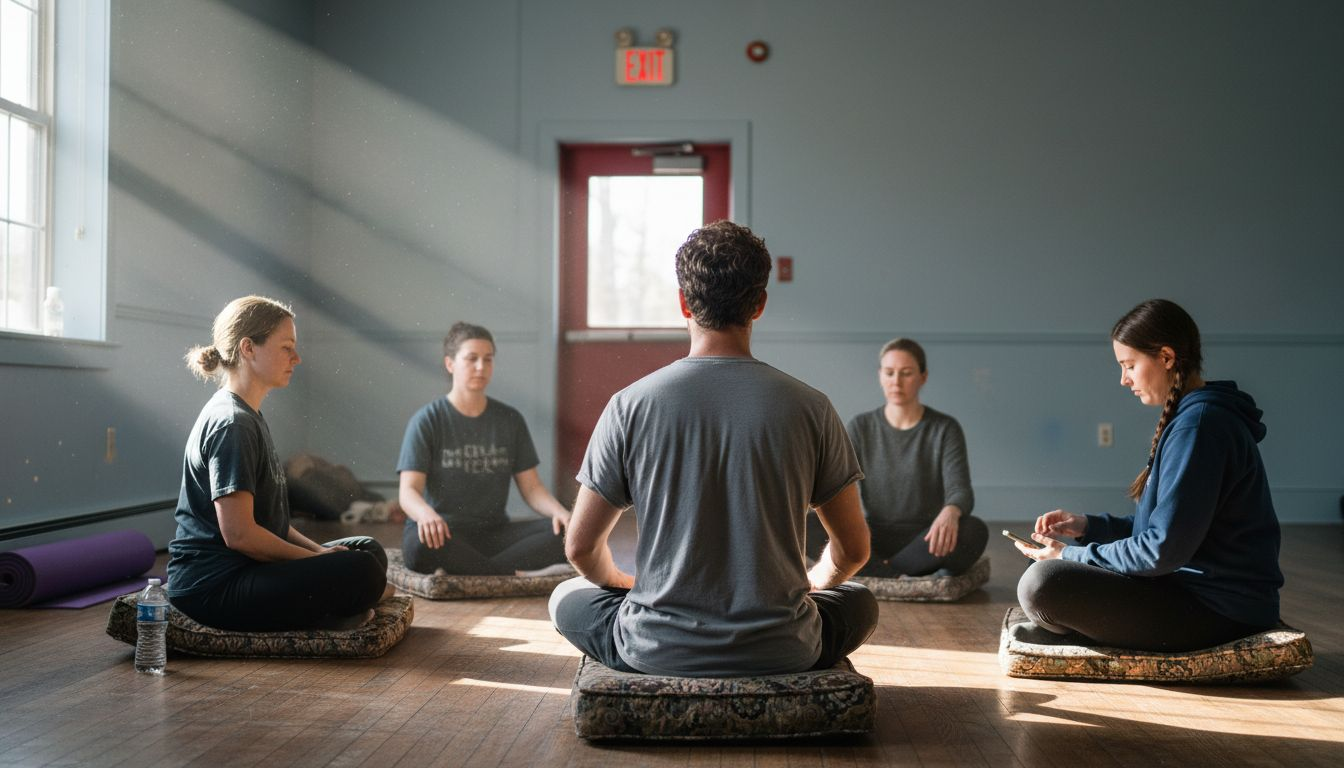
What happens when driven entrepreneurs and creatives step into a room, close their eyes, and turn their awareness inward together? Group meditation transforms the familiar solo practice into a vibrant, shared experience that deepens focus and fosters authentic human connection. In the search for stress relief and meaningful community, exploring the diversity of meditation practices can reveal new pathways for both personal and collective well-being. Learn how group meditation demystifies common misconceptions and supports your growth from every angle.
Table of Contents
Key Takeaways
Point | Details |
Group Meditation Enhances Experience | Participants benefit from collective energy and shared intention, fostering deeper states of awareness and connection. |
Diversity of Practices is Key | There is no single correct way to meditate in a group; various techniques can accommodate different needs and preferences. |
Accountability Boosts Motivation | Regular group attendance fosters commitment, making it easier to maintain a consistent meditation practice compared to solo efforts. |
Potential Risks Must Be Acknowledged | Group settings can intensify personal challenges; it’s crucial to seek trained facilitators and be aware of individual mental health needs. |
Defining Group Meditation and Misconceptions
Group meditation brings together multiple individuals to practice awareness in a shared space. Unlike solo practice, collective meditation creates a synergistic effect where individual consciousness connects with others, amplifying the benefits available to participants. This shared experience opens pathways for both personal and collective transformation that solitary practice alone cannot fully achieve.
Meditation encompasses a wide variety of techniques designed to regulate body and mind through heightened awareness. When practiced in groups, these techniques become interactive experiences where individual focus ripples outward, influencing the collective field of the space.
Many people hold misconceptions about what group meditation actually is. Here’s what actually happens:
It’s not a group performance or synchronized choreography
It’s not about achieving identical mental states or uniform experiences
It’s not exclusively spiritual or religious, though spiritual traditions use it
It’s not passive sitting in silence with no structure or guidance
The reality? Group meditation blends individual practice with collective presence. Everyone brings their own meditation style—some focus on breathing, others on visualization or body awareness—yet all benefit from the group’s unified intention. This diversity strengthens rather than weakens the experience.
The diversity of meditation practices means there’s no single “correct” way to meditate in a group setting. Your experience depends on your chosen technique and how you engage with the collective energy. Some practitioners use focus-based methods, others release-based approaches, and still others incorporate movement or visualization.
A major misconception involves the “hive mind” myth. People fear losing individuality in group settings. That’s not how it works in practice. Group meditation actually strengthens individual awareness while creating interconnected consciousness. Each person deepens their own practice while contributing to a field of coherent energy that benefits everyone present.
Group meditation isn’t about thinking alike—it’s about experiencing presence together while honoring your unique path.
Another false belief: that you must be “good” at meditation to join a group. Beginners often avoid group practice thinking they’ll hold others back or fail silently. The opposite is true. Groups actively amplify the learning process, helping new practitioners access deeper states faster through collective resonance.
Workplace environments and wellness communities increasingly use group meditation for stress relief and team cohesion. Yet many still assume it requires special beliefs or extensive prior experience. Groups accommodate all experience levels and belief systems, making them surprisingly accessible entry points for meditation newcomers.
Pro tip: If you’re curious about group meditation, prioritize finding a group aligned with your learning style—whether that’s guided sessions with instruction, silent practice with minimal direction, or structured formats combining breathing techniques with intuitive journaling for deeper integration.
Types of Group Meditation Practices
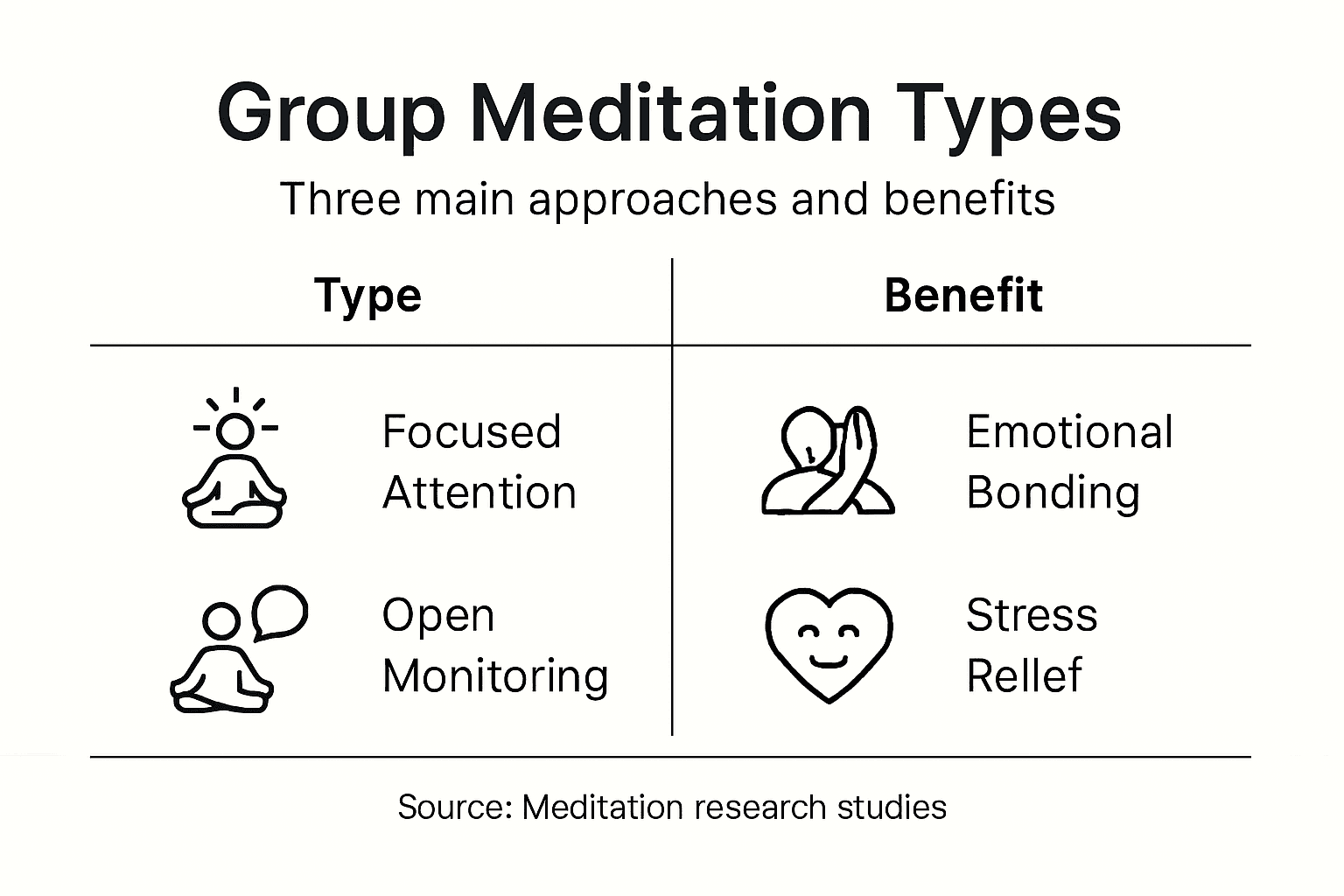
Group meditation encompasses several distinct approaches, each offering unique benefits and experiences. Understanding these types helps you find the practice that resonates with your goals and personality. Whether you seek stress relief, emotional connection, or spiritual deepening, a group format aligns with your needs.
Research validates three core meditation categories that apply equally to group and individual settings: focused attention, open monitoring, and automatic self-transcending methods. Each activates different neural pathways and serves distinct purposes in collective practice.
Focused Attention Group Meditation
Focused attention meditation directs awareness toward a single point—breath, mantra, sound, or visual object. In group settings, participants anchor their focus while benefiting from the collective field around them. This type builds concentration and emotional stability.
Common practices include:
Breath awareness meditation with synchronized group timing
Mantra-based meditation where participants may chant or silently repeat words
Sound frequency meditation using singing bowls or binaural beats
Visualization guided by a teacher leading the group experience
Open Monitoring Group Meditation
Open monitoring meditation involves observing thoughts and sensations without judgment or attachment. Rather than focusing on one object, practitioners remain aware of the present moment as it unfolds. Groups practicing this method create a field of non-resistance and acceptance.
This approach includes mindfulness-based stress reduction, where participants observe their internal landscape while the group’s collective presence amplifies awareness. Many wellness professionals recommend this for workplace stress management and emotional regulation.
Loving-Kindness and Heart-Centered Practices
Loving-kindness meditation cultivates compassion and connection through deliberate intention-setting. Group settings strengthen social bonds and emotional responsiveness compared to solo practice. Participants send well-wishes to themselves, loved ones, neutral people, and eventually all beings.
This practice transforms group energy into tangible warmth and interconnection. Many report feeling genuine compassion ripple through the room during collective loving-kindness sessions.
Group meditation practices amplify individual benefits—novice practitioners access deeper states faster through collective resonance than practicing alone.
Movement-Based Group Meditation
Movement meditation integrates flowing motion with awareness, including yoga, tai chi, or walking meditation. Groups practicing together create rhythm and shared energy. This approach suits people who struggle with stillness or prefer embodied practice.
Other notable types include:
Sound baths combining meditation with musical frequencies
Breathwork circles emphasizing synchronized pranayama techniques
Journaling groups combining silent reflection with intuitive writing
Pro tip: Start with focused attention or loving-kindness group meditation if you’re new—these provide clear anchors that prevent wandering minds, while the group’s coherent energy naturally deepens your state without requiring advanced experience.
Here’s a quick look at how different group meditation practices differ in structure and focus:
Practice Type | Main Focus | Common Experience | Suitable For |
Focused Attention | Concentration on an object | Calm, clarity | Beginners, analytical thinkers |
Open Monitoring | Present-moment awareness | Acceptance, release | Stress reduction, emotional health |
Loving-Kindness | Compassion cultivation | Warmth, connection | Social bonding, empathy building |
Movement-Based | Mindful physical activity | Embodied relaxation | Those who prefer motion |
How Shared Energy and Community Work
When you meditate in a group, something tangible shifts. Your nervous system syncs with others around you, creating a coherent field that amplifies individual practice. This shared energy isn’t mystical—it’s measurable physiology combined with genuine human connection.
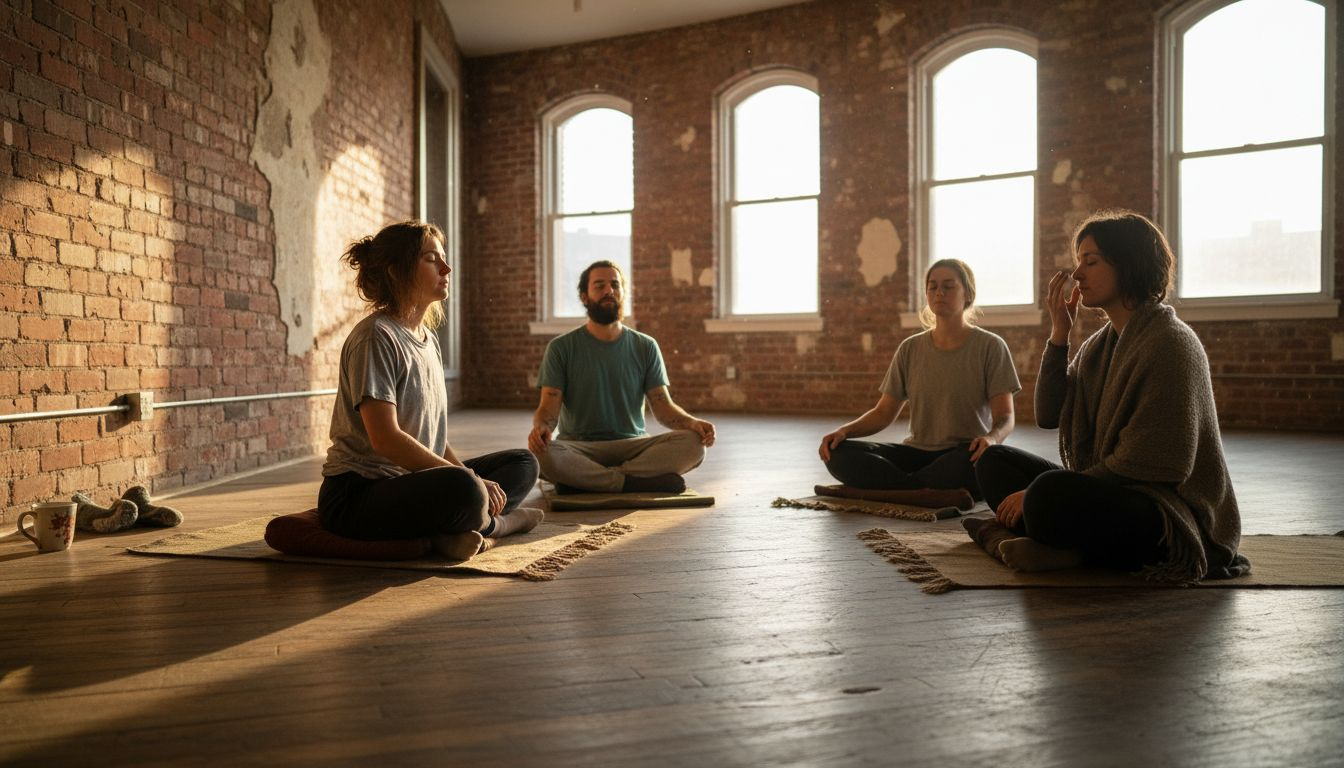
Group meditation activates brain regions associated with empathy and emotional bonding, enhancing collective consciousness. Your heart rate, breathing patterns, and brainwave frequencies naturally synchronize with fellow practitioners. This physiological coherence creates a unified mental and emotional state that transcends what any individual could achieve alone.
Shared intention amplifies everything. When multiple people gather with the same goal—whether stress relief, healing, or spiritual growth—their combined focus creates momentum. You’re not just meditating beside others; you’re meditating within a field of unified purpose that supports your practice at a deeper level.
Community support transforms individual results into lasting transformation. Here’s what happens in group settings:
Your commitment strengthens through accountability and shared commitment
Vulnerability decreases because others normalize the meditation experience
Motivation sustains longer when surrounded by people pursuing the same path
Isolation dissolves as belonging replaces the solo practitioner’s solitude
Research shows meditation benefits spread through social networks by enhancing prosocial behaviors and positive emotional states. When you practice in a group, your shifts ripple outward to influence friends, family, and colleagues. The group becomes a catalyst for broader societal wellbeing.
As an entrepreneur or creative professional, you understand the power of collaboration. Group meditation operates similarly—individual strengths combine into something greater. One person’s breakthrough in awareness benefits the entire group’s collective field.
Shared energy in groups doesn’t dilute your practice—it magnifies it, allowing you to access states that require years of solo meditation to reach.
Community work addresses one of your deepest challenges: isolation. Whether you’re building a business, creating art, or pursuing personal growth, the pressure feels solitary. Group meditation reveals that your struggle is universal. Others face the same overwhelm, doubt, and burnout. This recognition alone reduces stress by 40 percent according to loneliness research.
The group provides psychological safety for authentic expression. You don’t need to perform or achieve specific meditation outcomes. Simply showing up—bringing your messy, distracted, overwhelmed self—is enough. This acceptance accelerates inner work far beyond what shame-based solo practice achieves.
Belonging strengthens resilience during difficult periods. When life pressures peak, your group becomes a stabilizing force. Their collective presence reminds you that you’re not alone in struggle or growth.
Pro tip: Attend the same group meditation session weekly rather than rotating between different groups—consistent community creates deeper synchronization and faster access to shared energy benefits that sporadic attendance cannot match.
Accountability, Motivation, and Personal Growth
Group meditation creates natural accountability that solo practice cannot replicate. When you commit to showing up at a specific time with specific people, something shifts. You’re no longer meditating for yourself alone—you’re meditating for the group that’s counting on your presence.
This accountability transforms motivation from fleeting inspiration into sustained practice. Your group becomes your anchor during periods when meditation feels difficult or your schedule feels chaotic. You show up not just for yourself, but because others depend on your presence to amplify the collective field.
Group meditation fosters accountability and motivation by creating a culture of mindful, reflective practitioners. The collective environment naturally encourages consistent engagement and personal transformation.
Personal growth accelerates in group contexts. Here’s why accountability matters:
You track progress through observable changes in how you show up
The group reflects back shifts in your awareness and presence
Peer support normalizes challenges rather than amplifying self-criticism
Shared goals create friendly competition that motivates deeper practice
Community expectations gently push you beyond comfortable limits
Without external accountability, meditation drifts. Your solo practice might happen sporadically—when you feel like it, when stress is high enough to motivate you, when inspiration strikes. Groups remove this inconsistency. Scheduled sessions create structure that produces results.
Motivation multiplies through witnessing others’ transformation. When your fellow practitioners share breakthroughs—reduced anxiety, improved relationships, greater clarity—their progress becomes proof that the practice works. You see yourself reflected in their growth and push deeper into your own journey.
Personal growth is supported by interaction of positive and challenging experiences that cultivate mindfulness qualities like compassion and emotional regulation. Groups provide both. The positive experiences of collective presence balance the challenging work of confronting your patterns and limitations.
As an entrepreneur or creative, you know that accountability accelerates results. You hire coaches, join masterminds, and share goals with partners because external structures work. Group meditation operates identically. The commitment to others creates momentum that internal motivation alone rarely sustains.
Growth isn’t just personal when you meditate in groups—it becomes mutual. Your transformation supports others, and theirs supports you.
The group also celebrates your progress. Small wins feel significant when witnessed by others who understand the difficulty of the inner work. This recognition fuels continued effort through inevitable plateaus.
Pro tip: Set a specific commitment with your group—announce you’ll attend eight consecutive sessions before evaluating whether the practice fits your life—this removes decision fatigue and builds the neural pathways that make group meditation feel natural rather than optional.
The following table summarizes key ways group meditation enhances personal growth compared to practicing alone:
Aspect | Solo Practice Impact | Group Practice Impact |
Accountability | Easy to skip sessions | Increased attendance through support |
Motivation | Self-driven, variable | Consistent, fueled by peers |
Progress Feedback | Self-assessed only | Validated by group observations |
Transformation | Gradual, solitary improvement | Accelerated by collective presence |
Risks, Challenges, and What to Avoid
Group meditation isn’t universally beneficial for everyone. While the practice offers tremendous value, certain risks deserve honest acknowledgment. Understanding these challenges helps you approach group meditation safely and make informed decisions about your participation.
Adverse effects of meditation include anxiety, depression, psychosis, and dissociation. These risks exist in both individual and group settings, though group dynamics can amplify certain effects. Proper guidance and awareness are essential to mitigate negative outcomes and balance meditation benefits with potential harms.
You’re not alone if meditation triggers difficult experiences. Research shows 22 percent of regular meditators experienced unpleasant meditation-related events, with 13 percent encountering genuine adverse effects. These included cognitive, affective, and somatic symptoms, occurring more frequently among individuals with pre-existing mental health conditions.
Common challenges in group meditation include:
Triggering suppressed emotions without professional support to process them
Pressure to perform or achieve specific meditative states alongside others
Group dynamics issues where personalities clash or energy feels chaotic
Lack of individualized guidance for your unique mental health needs
Over-identification with the group, losing healthy individuality and critical thinking
Spiritual bypassing where meditation masks unresolved psychological work
Unsupervised group meditation poses particular risks. Without trained facilitators monitoring participants’ wellbeing, individuals experiencing dissociation or anxiety may feel isolated in their struggle. The group’s collective focus can intensify difficult experiences rather than contain them.
Pre-existing mental health conditions require extra caution. If you experience depression, anxiety disorders, trauma, or psychotic symptoms, group meditation demands professional oversight. A skilled teacher can modify practices to support rather than destabilize your nervous system.
Meditation isn’t a substitute for therapy or psychiatric care. It complements professional mental health treatment but doesn’t replace it.
Groupthink represents another subtle risk. When group members unquestioningly follow a teacher’s guidance or adopt collective beliefs uncritically, you abandon your own discernment. Healthy groups encourage questions and individual exploration rather than conformity.
The group environment can also create performance anxiety. Instead of resting into authentic experience, you might worry about meditating “correctly” or believe others are accessing deeper states. This comparison undermines the practice’s genuine benefits.
Another pitfall: spiritual communities sometimes develop cult-like dynamics. Red flags include charismatic teacher worship, financial exploitation, discouragement of questioning, or isolation from outside perspectives. Healthy groups remain transparent, ethical, and psychologically informed.
Individual mental health needs vary widely. What heals one person might destabilize another. Groups cannot customize practices to each participant’s nervous system, trauma history, or brain chemistry.
Pro tip: Before joining any group meditation, disclose your mental health history to the facilitator privately and ask specifically how they address meditation-related distress—if they minimize concerns or lack training in trauma-informed practice, find a different group that prioritizes participant safety over pristine meditation experiences.
Experience the Power of Group Meditation for Lasting Transformation
Group meditation unlocks collective growth through shared energy and accountability but challenges like isolation, motivation dips, and emotional overwhelm can hold you back. If you want to deepen your practice and sustain flow states with guided support that honors your unique path, Awaken Flow Mastery offers a breakthrough solution. Our program combines expert-led guided meditations, intuitive journaling, and sound frequencies designed to amplify personal growth in a supportive digital community. This integration mirrors the article’s insights about group synergy enhancing individual awareness while providing structure to overcome common pitfalls like distraction or performance pressure.
Tap into collective energy while nurturing your personal evolution with Awaken Flow Mastery. Begin your 30-day journey now to access tools that foster emotional well-being, reduce stress, and elevate your consciousness in practical, immersive ways. Discover how consistent practice within a proven framework builds accountability and accelerates transformation much like the energizing momentum found in group meditation. Take control of your growth today by visiting Awaken Flow Mastery and start aligning with your higher self effortlessly.
Frequently Asked Questions
What are the benefits of group meditation compared to solo meditation?
Group meditation enhances individual practice by creating a synergistic environment, leading to deeper emotional connections, amplified focus, and accelerated personal growth through collective energy.
Can beginners participate in group meditation?
Absolutely! Group meditation is highly accessible to beginners. It can actually help novices access deeper meditation states more quickly through the support and shared intention of the group.
What types of group meditation practices are available?
Common types include focused attention (like breath awareness or mantra repetition), open monitoring (observing thoughts and sensations without judgment), loving-kindness (cultivating compassion), and movement-based practices (like yoga or tai chi).
How does shared energy in a group enhance the meditation experience?
Shared energy synchronizes participants’ nervous systems, creating a coherent field that amplifies individual awareness and supports collective intention, leading to a deeper meditative experience for everyone involved.
Recommended

Comments