
Mindfulness vs Flow – Impact on Creativity and Well-being
Every creative entrepreneur has faced the question: how do you stay calm and aware while producing your best work? The confusion between mindfulness and flow stems from their similar language, but each shapes your mind differently. For spiritual entrepreneurs, understanding these distinct states unlocks strategies for deeper meditation, emotional balance, and high productivity. Discover how combining present-centered awareness with immersive creative focus transforms your well-being and daily performance.
Table of Contents
Key Takeaways
Point | Details |
Mindfulness vs. Flow | Mindfulness involves present-centered awareness without judgment, while flow is characterized by complete immersion and active engagement in activities. |
Complementary Practices | Both mindfulness and flow enhance well-being, but they serve different purposes and can be used together for greater creativity and productivity. |
Integration for Peak Performance | Combining mindfulness preparation with focused work facilitates easier access to flow states, maximizing creative output and emotional stability. |
Building a Routine | Establish a daily practice of mindfulness followed by clear intention-setting to optimize conditions for achieving flow effectively. |
Defining Mindfulness and Flow States
Mindfulness and flow often get confused because they sound similar, but they operate through different mechanisms in your brain and produce distinct experiences. Understanding how they differ—and how they complement each other—shapes your entire approach to creativity, productivity, and well-being.
What Mindfulness Actually Is
Mindfulness is present-centered awareness paired with acceptance and non-judgment. It’s about observing what’s happening right now—your breath, sensations, thoughts, emotions—without trying to change or control anything.
Think of mindfulness like watching clouds pass across the sky. You notice them, acknowledge them, and let them drift by. You’re not chasing any particular cloud or pushing them away.
Research defines mindfulness as non-judgmental, present-moment attention to body sensations, emotions, cognitions, and your environment, coupled with an equanimous, allowing attitude. It’s fundamentally a receptive practice—you’re not forcing anything to happen.
Key characteristics of mindfulness include:
Present focus: Your attention stays anchored to this moment, not past regrets or future worries
Non-judgment: You observe experiences without labeling them as good or bad
Acceptance: You allow things to be as they are, rather than resisting or controlling them
Bare attention: You notice sensations and thoughts without analysis or storytelling
What Flow States Really Are
Flow is the opposite experience. It’s full immersion and optimal engagement in an activity where you lose track of time and self-consciousness. You’re completely absorbed.
When you’re in flow, you’re not observing yourself. You’re merged with the activity itself. Writing flows when words pour out without deliberation. Creating flows when you look up and realize three hours passed. Working flows when challenges match your skills perfectly.
Flow requires focus, but it’s an active, engaged focus—not the passive observation of mindfulness. You’re performing, creating, problem-solving with total commitment.
How They’re Related But Different
A 2023 meta-analysis examining the relationship between mindfulness and flow across 17 studies and over 10,000 participants found a moderate positive association. They do influence each other.
But here’s the distinction:
Mindfulness = observation + acceptance + presence
Flow = immersion + absorption + active engagement
Both connect to psychological well-being, but through different pathways. Mindfulness quiets your mind’s resistance. Flow channels your entire capacity into one direction.
Here’s a side-by-side comparison to clarify how mindfulness and flow operate differently and when each is best applied:
Aspect | Mindfulness | Flow State |
Dominant Focus | Observing experience | Merging with activity |
Engagement Level | Passive, reflective | Active, immersive |
Self-Awareness | Maintains observer perspective | Loss of self-consciousness |
Ideal Use Case | Emotional regulation, stress relief | Maximizing creativity, peak performance |
Pro tip: Start your day with a brief mindfulness practice to calm your nervous system, then transition into focused work where flow can emerge naturally—the internal quiet mindfulness creates makes flow states easier to access.
Distinct Characteristics and Core Benefits
While mindfulness and flow both enhance well-being, they work through distinctly different pathways. Recognizing these differences helps you deploy each practice strategically—using mindfulness when you need calm awareness and flow when you need creative momentum.
The Core Difference in How They Work
Mindfulness is a passive, observing state where you witness your experience without judgment. You’re watching your mind like you’re sitting on the bank of a river, noticing thoughts float by.
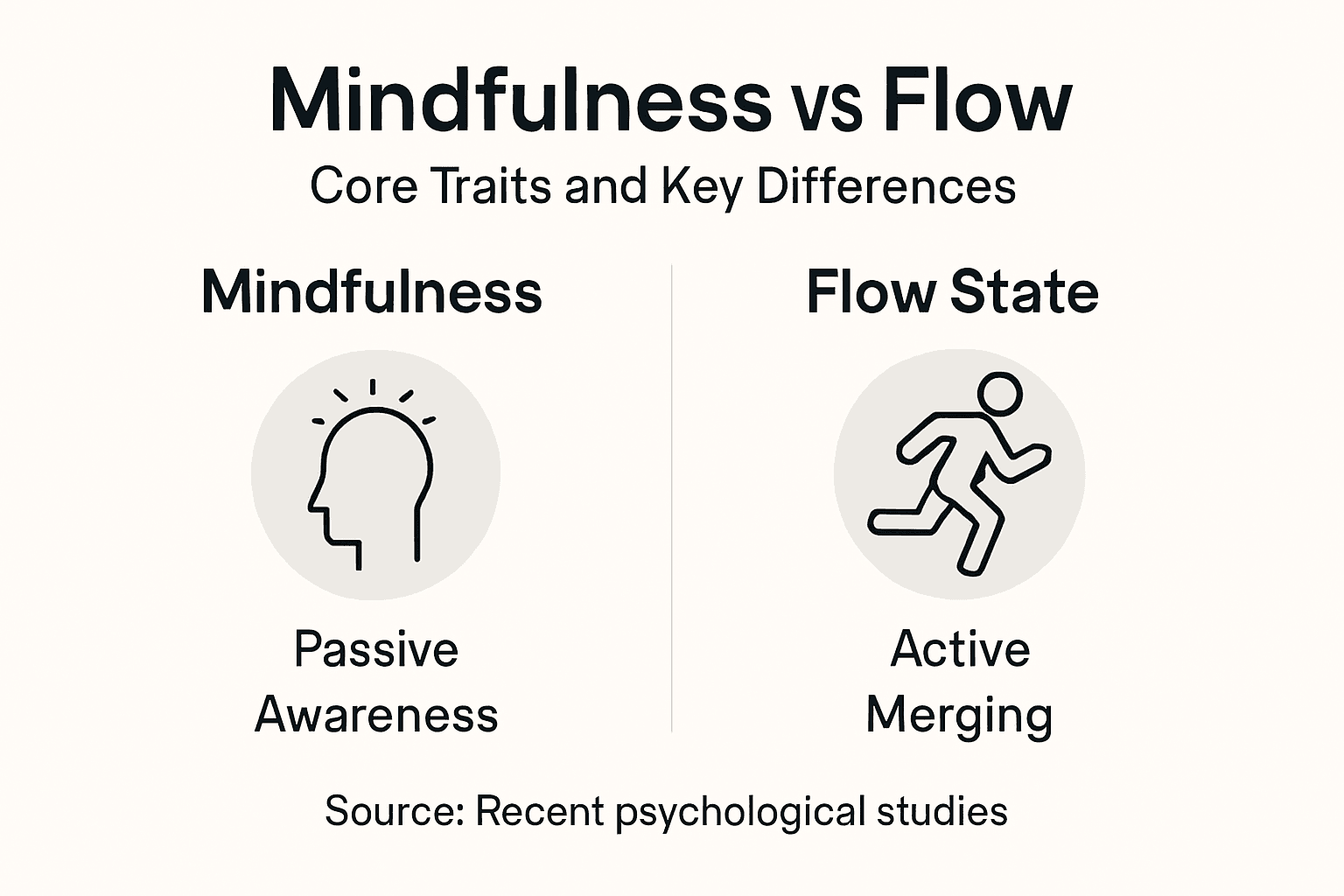
Flow is an active, deeply engaged state where you merge completely with what you’re doing. You’re not observing—you’re performing, creating, solving. Your sense of self dissolves into the activity itself.
This distinction matters because they activate different parts of your brain and serve different purposes in your life.
What Mindfulness Actually Delivers
When you practice mindfulness regularly, you build lasting traits that stick with you. This is why meditation creates sustainable change—you’re training your nervous system, not just having a temporary experience.
Mindfulness offers specific benefits:
Emotional regulation: You respond to triggers rather than react automatically
Equanimity: Difficulties feel manageable because you’re not resisting them
Self-awareness: You understand your patterns, habits, and habitual reactions
Resilience: Challenges don’t destabilize you because you’ve built internal stability
Reduced anxiety: Your nervous system quiets because you’re not fighting reality
Research shows mindfulness facilitates emotional regulation and resilience through sustained, present-moment awareness. This is foundational work for well-being.
What Flow States Actually Deliver
Flow is a transient experience—it comes and goes—but when it arrives, you accomplish remarkable things. Flow is where peak performance lives.
Flow offers distinct benefits:
Intrinsic motivation: You’re driven by the activity itself, not external rewards
Intense focus: Distractions disappear; your attention is laser-focused
Enjoyment: The work itself feels deeply satisfying
Optimal performance: Your skills align perfectly with the challenge
Creative breakthroughs: Solutions emerge naturally when you’re fully immersed
Flow is marked by intense focus and intrinsic motivation during challenging activities. This is where your best creative work happens.

Using Them Together
The most powerful approach combines both practices. Mindfulness-in-flow—sometimes called “mindflow”—lets you access flow states while maintaining awareness of what’s happening.
You stay present without getting lost in self-judgment or distraction. You perform at your peak while remaining grounded.
Both mindfulness and flow enhance creativity, productivity, and psychological well-being, but through complementary mechanisms that work together naturally.
Pro tip: Use mindfulness to prepare your mind for flow—spend five minutes calming your nervous system before starting creative work, then let focus deepen naturally as you engage with the task.
Common Misconceptions and Overlaps
One of the biggest mistakes spiritual entrepreneurs make is treating mindfulness and flow as completely separate practices. In reality, they overlap significantly and support each other in ways that enhance both creativity and well-being.
The “They’re Mutually Exclusive” Myth
Many people believe you can’t be mindful and in flow at the same time. They think mindfulness means stepping back from the action, while flow means losing awareness entirely.
This is backward. Research reveals flow and mindfulness share a significant positive correlation among practitioners, suggesting they’re deeply interconnected rather than opposed.
You can be fully immersed in creative work while maintaining non-judgmental awareness of the experience. That’s the sweet spot.
Where They Actually Overlap
Both practices involve present-moment focus. Whether you’re observing your breath or absorbed in writing, you’re anchored in now—not lost in past regrets or future anxiety.
Both practices reduce self-consciousness. Mindfulness quiets the inner critic; flow dissolves your sense of self entirely. Both outcomes free you from judgment.
Both enhance psychological well-being through different mechanisms that reinforce each other naturally.
Key overlaps include:
Present-moment anchoring: Your attention stays in now, regardless of which practice you’re using
Reduced mental chatter: Both silence the stream of unhelpful thoughts
Non-reactivity: You respond consciously rather than react automatically
Enhanced awareness: You notice more clearly what’s actually happening
Where They Genuinely Differ
The distinction lies in engagement level and focus direction. Research clarifies that mindfulness focuses on non-judgmental awareness while flow emphasizes immersion and challenge-skill balance.
Mindfulness is receptive. Flow is active and absorptive.
Mindfulness observes experience. Flow merges with experience.
Mindfulness maintains awareness of the observer. Flow dissolves the observer into the activity.
The Integration Advantage
The most powerful approach integrates both. You use mindfulness to prepare your nervous system and clear mental clutter, then step into flow where creative breakthroughs happen.
Mindfulness creates the internal stability that allows flow to emerge. Flow channels that stability into peak performance.
Mindfulness facilitates present-moment awareness that fosters flow states, while flow involves deep task absorption—they work together naturally when you understand how each contributes to the whole experience.
Pro tip: Notice when you slip into judgment during creative work, gently return to present-moment awareness like you would in meditation, then let flow deepen naturally as you re-engage with the task.
Practical Applications for Personal Growth
Understanding mindfulness and flow theoretically is one thing. Applying them strategically to your life is where transformation actually happens. For spiritual entrepreneurs seeking deeper meditation practice and creative productivity, these practices become tools for measurable personal development.
Building a Foundation with Mindfulness
Start with daily meditation practice to establish the nervous system stability that makes flow possible. This isn’t about achieving blissful states—it’s about creating internal space where clarity emerges naturally.
Regular mindfulness practice directly enhances your capacity to recognize and enter flow states. When your mind is calmer and less reactive, flow arrives more easily because there’s less internal resistance blocking it.
Begin with these foundational steps:
Consistent timing: Practice at the same time daily to establish neural patterns
Short duration: Five to ten minutes builds momentum better than sporadic longer sessions
Simple focus: Return attention to breath whenever your mind wanders
Non-judgment: Notice distraction without criticism and gently refocus
Research shows mindfulness acts as a key mechanism linking flow to emotional intelligence and enhanced engagement across all activities. This means your meditation practice literally rewires your brain to access flow more readily.
Creating Conditions Where Flow Emerges
Flow doesn’t happen accidentally. It requires specific conditions that you can deliberately engineer into your work and creative practice.
The challenge-skill balance matters most. Your task difficulty should match your current skill level—not too easy (boring) and not overwhelming (anxious). Adjust difficulty as your skills improve.
Practical ways to cultivate flow conditions:
Eliminate distractions: Phone off, notifications silenced, dedicated workspace
Set clear goals: Know exactly what you’re working toward in this session
Provide immediate feedback: Track progress visibly so you know how you’re performing
Create time blocks: Uninterrupted focus periods of ninety minutes strengthen flow capacity
Integrating Both Practices
The most powerful approach combines mindfulness preparation with flow-focused work. Think of it as a two-phase system.
Phase one (five to ten minutes): Meditation clears mental clutter, stabilizes your nervous system, and prepares your awareness. Mindfulness training combined with environmental adjustments enables employees to engage more fully in tasks.
Phase two (ninety-minute blocks): Move into focused work where flow can deepen. Your calm, prepared mind now finds it easier to merge with the activity.
This two-phase rhythm works for creative projects, client work, spiritual practices, or any activity requiring deep engagement.
Tracking Your Growth
Measure what shifts as you integrate these practices:
How easily do you enter focused work states?
How long can you sustain concentration before distraction pulls you away?
How quickly do you recognize and release unhelpful thought patterns?
How often do you lose track of time while engaged in meaningful work?
Personal growth through mindfulness and flow accelerates when you have daily practices, deliberate environmental conditions, and honest reflection on what’s changing.
Pro tip: Keep a brief journal after each work session noting whether you experienced flow, what conditions supported it, and what internal or external factors disrupted it—patterns emerge quickly that show you exactly how to engineer more flow into your creative practice.
Integrating Mindfulness and Flow Practices
The real magic happens when you stop treating mindfulness and flow as separate practices and start weaving them together intentionally. This integrated approach—sometimes called “mindflow”—creates a powerful synergy that amplifies both creativity and well-being beyond what either practice alone can achieve.
Understanding the Mindflow Model
Mindflow combines mindfulness’s passive observation and acceptance with flow’s active, deep engagement. You’re not choosing one over the other—you’re using both strategically in sequence.
Think of it like this: mindfulness prepares the soil, and flow plants the seeds where growth happens. One creates the conditions; the other channels your full capacity into meaningful work.
Mindfulness and flow are synergistic phenomena that maximize creativity and productivity when integrated deliberately. The key is understanding the timing and sequencing of each practice.
The Three-Stage Integration Process
Here’s how to build mindflow into your daily practice:
Stage one—Preparation (five to ten minutes): Begin with meditation to settle your mind and activate present-moment awareness. This is where you cultivate non-judgmental attention and emotional regulation.
Stage two—Transition (one to two minutes): Set a clear intention for your work session and identify the specific task requiring your focus. This brief pause bridges mindfulness and flow.
Stage three—Engagement (sixty to ninety minutes): Step into focused work where flow can deepen naturally. Your prepared mind now finds it easier to merge completely with the activity.
This rhythm works across creative projects, spiritual practices, client work, or any endeavor requiring deep concentration.
The following table offers a practical summary of how to strategically integrate mindfulness and flow in daily routines:
Integration Stage | Key Action | Result |
Preparation | Brief meditation or breathing | Calms and centers the mind |
Transition | Set clear intention for work | Focuses attention, reduces hesitation |
Engagement | Deep work on one challenge | Eases entry into flow and productivity |
Practical Integration Techniques
Implement these specific methods to strengthen your mindflow capacity:
Anchor your intention: At the end of meditation, state clearly what you’re about to create or complete
Remove friction: Delete obstacles before starting so your mind stays merged with the work
Track early signals: Notice when you first feel attention deepening and celebrate that shift
Use daily meditation routines to build consistent nervous system preparation for flow access
Journal after sessions: Mindful journaling captures insights about what conditions trigger your flow most reliably
Why This Works Better Than Either Alone
Mindfulness alone quiets your mind but doesn’t channel that quiet into productivity. Flow alone can become frantic without the emotional regulation mindfulness provides.
Together, they create sustainable peak performance. Integration of mindfulness practice enhances the likelihood and quality of flow experiences by fostering sustained attention and emotional resilience.
You’re not just productive—you’re sustainably creative while remaining emotionally grounded.
Mindflow—the integration of mindfulness’s calm awareness with flow’s engaged focus—creates a state where you accomplish remarkable work while remaining internally stable and present.
Pro tip: Track your mindflow sessions for two weeks, noting how long meditation lasts before you transition to work and how quickly you enter deep focus—you’ll discover your personal rhythm and can optimize timing for maximum creative output.
Unlock Your Creative Potential by Mastering Mindfulness and Flow
If you find yourself caught between needing calm awareness and craving deep creative engagement this article on “Mindfulness vs Flow – Impact on Creativity and Well-being” highlights the challenges many face balancing these powerful states. You may struggle with scattered thoughts that block flow or feel overwhelmed trying to stay present without losing focus. The key pain points described include overcoming mental resistance, managing emotional reactivity, and sustaining full immersion in your work—precisely the difficulties that stop many from reaching their highest creative and well-being potential.
At Awaken Flow Mastery, we understand how crucial it is to cultivate both mindfulness and flow in harmony for lasting transformation. Our comprehensive meditation and energy alignment program offers a proven 30-day guided series that combines intuitive journaling, sound frequencies, and integration practices designed to calm your nervous system while building the foundation for effortless flow states. This approach directly addresses the article’s concepts of preparing your mind through non-judgmental awareness before engaging in deep immersive work.
Experience the difference when you learn to balance receptive mindfulness with active flow using tools rooted in over a decade of energy work expertise. Begin your journey today to release stress, sharpen focus, and awaken sustained creativity by visiting the Awaken Flow Mastery homepage. Explore how our guided meditations, supportive resources, and community empower your personal growth and help you fully align with your higher self. Don’t wait to transform your daily routine into a life-changing practice—take your next step now toward seamless flow and mindful presence.
Frequently Asked Questions
What is the difference between mindfulness and flow?
Mindfulness is present-centered awareness with acceptance and non-judgment, focusing on observing experiences in the moment. Flow, on the other hand, is characterized by complete immersion and engagement in an activity, where one loses track of time and self-consciousness.
How can I incorporate mindfulness into my daily routine?
You can start with a daily meditation practice, setting aside five to ten minutes for focused breathing and observing your thoughts without judgment. Consistent timing and short duration can help establish a strong mindfulness habit.
How does flow contribute to creativity?
Flow enables peak performance and creative breakthroughs by fostering intense focus, intrinsic motivation, and optimal skill-challenge balance. When in flow, distractions vanish, allowing for deep engagement in creative tasks.
Can mindfulness and flow be practiced together?
Yes, incorporating both practices can enhance creativity and well-being. By starting with mindfulness to calm the mind and then transitioning into focused work, you create the conditions for flow to emerge naturally.
Recommended

Comments