
Discover the role of journaling in healing and growth

Recent studies reveal that writing for just 15-20 minutes daily produces measurable mental health improvements, yet most people dismiss journaling as simple diary keeping. The truth is far more powerful. Journaling serves as a scientifically validated tool for emotional healing, offering concrete benefits like reduced anxiety, improved emotional regulation, and enhanced resilience. This guide explains exactly how journaling promotes healing and provides practical techniques you can start using today to support your personal growth and spiritual well-being.
Table of Contents
Key takeaways
Point | Details |
Evidence-based healing | Journaling reduces anxiety, stress, and PTSD symptoms through measurable brain changes. |
Consistency matters most | Short daily sessions outperform sporadic long writing for emotional regulation benefits. |
Therapeutic focus required | Emotional exploration differs from casual event recording and drives healing outcomes. |
Multiple proven methods | Expressive writing, gratitude, and stress journaling each offer unique healing pathways. |
Meditation synergy | Combining journaling with meditation amplifies emotional healing and spiritual growth. |
How journaling promotes emotional healing and mental wellness
When you write about emotional experiences, you externalize feelings that would otherwise loop endlessly through your mind. This process reduces cognitive load, freeing mental resources for problem solving and emotional regulation. Your brain responds to journaling in measurable ways that directly support healing.
Research shows that expressive writing activates reasoning centers while quieting fear responses in the brain. Specifically, journaling engages your prefrontal cortex, the area responsible for rational thinking and emotional control. This activation helps calm the amygdala, your brain’s alarm system that triggers anxiety and stress reactions. The result is a natural reduction in emotional intensity and improved mental clarity.
The benefits extend beyond brain activity to physical health markers:
Reduced cortisol levels decrease overall stress response
Improved working memory enhances daily functioning
Strengthened immune system reduces illness frequency
Better sleep quality supports emotional recovery
Pro Tip: Write about the same emotional experience for three consecutive days to maximize healing benefits, as repeated processing helps your brain fully integrate difficult emotions.
Naming emotions in writing creates what psychologists call affect labeling. When you identify and describe feelings precisely, you literally dial down their intensity. This isn’t just feeling better, it’s your brain rewiring its response patterns. Studies confirm that writing about emotional experiences for multiple days improves mental health outcomes significantly.
The healing mechanism works through narrative construction. As you write, you create coherent stories from fragmented emotional experiences. This organization helps your brain process trauma and stress more effectively than rumination alone. Your mind shifts from reactive emotional loops to reflective understanding, a crucial step in genuine healing.

Exploring mindful journaling examples reveals how intentional writing practices deepen emotional awareness. Similarly, following an intuitive journaling guide can improve emotional balance by 60% when practiced consistently. These approaches move beyond surface level documentation to genuine emotional exploration.
Different journaling techniques for effective healing
Expressive writing forms the foundation of therapeutic journaling. This method involves writing continuously about emotional experiences for 15-20 minutes, focusing on your deepest thoughts and feelings without concern for grammar or structure. The goal is emotional release and processing, not literary quality.
Gratitude journaling offers a different healing pathway by redirecting attention toward positive experiences. Research demonstrates that positive journal writing for 10 minutes daily over 15 days decreases mental distress and increases resilience. This technique proves especially valuable during health challenges or difficult life transitions.
Technique | Primary Focus | Healing Benefit | Best For |
Expressive Writing | Deep emotional exploration | Trauma processing, anxiety reduction | Past experiences, unresolved emotions |
Gratitude Journaling | Positive experiences | Resilience building, mood improvement | Daily practice, health challenges |
Stress Journaling | Current stressors | Emotional regulation, clarity | Overwhelming situations, decision making |
Therapeutic Journaling | Emotion processing | Self-awareness, pattern recognition | Personal growth, behavioral change |
Stress journaling requires awareness of common pitfalls. Avoid rumination by setting time limits and focusing on solutions rather than endless problem analysis. Perfectionism undermines healing, so write freely without self-judgment. The stress journaling mistakes people make often stem from treating journaling like performance rather than process.
Therapeutic journaling distinguishes itself through intentional emotional focus. Rather than recording events chronologically, therapeutic journaling focuses on processing emotions and understanding patterns. You explore why events affected you, what feelings emerged, and how experiences connect to deeper beliefs or wounds.
Pro Tip: Start each session with a specific emotional question like “What am I avoiding feeling right now?” to guide deeper exploration beyond surface thoughts.
Consistency trumps duration for healing outcomes. Writing 10 minutes daily produces better results than occasional hour long sessions. Your brain benefits from regular emotional processing rather than sporadic intense releases. Building this habit supports ongoing emotional regulation and self-awareness.
Integrating mindfulness stress relief practices with journaling creates a powerful healing combination. Begin with brief meditation to center yourself, then write about insights or emotions that surface. This approach enhances both practices and deepens healing potential.
Journaling’s impact on resilience, mental health, and spiritual growth
Regular journaling builds genuine resilience by strengthening your capacity to process difficult emotions. Studies tracking long term practitioners show significant reductions in depression and anxiety symptoms. The practice doesn’t eliminate challenges, but it fundamentally changes how you respond to them.
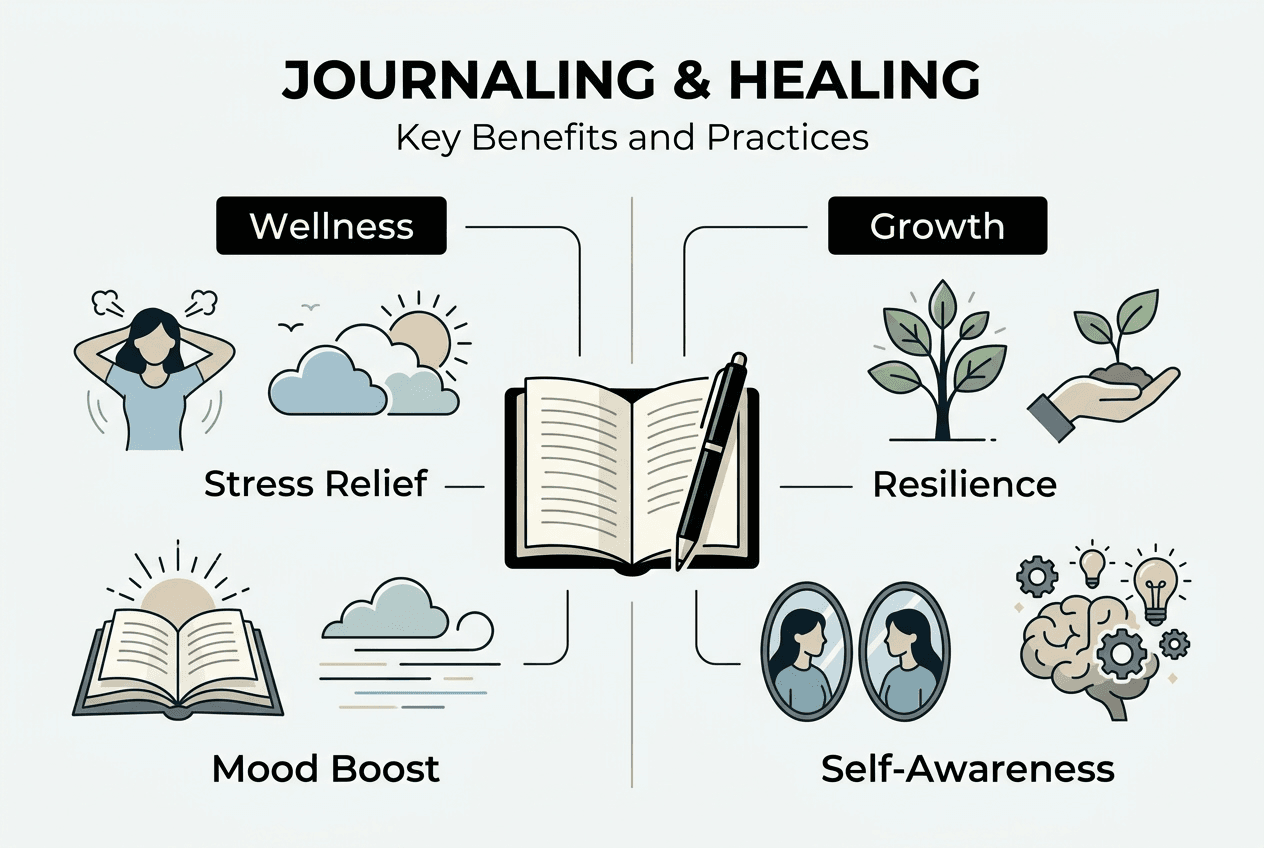
College students using expressive writing show remarkable adaptation benefits. Research found that nursing students showed significant stress reduction and improved college adjustment after expressive writing intervention. These students handled academic pressure more effectively and reported better emotional well-being throughout demanding programs.
Health Outcome | Improvement Rate | Study Duration | Mechanism |
Anxiety Reduction | 25-40% decrease | 3-6 weeks | Emotion regulation, cognitive reframing |
Depression Symptoms | 30% improvement | 4-8 weeks | Narrative coherence, meaning making |
Sleep Quality | 35% better rest | 2-4 weeks | Reduced rumination, stress processing |
Immune Function | Fewer sick days | 6 months | Lower cortisol, improved cellular response |
The mental health benefits extend beyond symptom reduction to fundamental psychological growth. Journaling reduces depression, anxiety and improves physical health through multiple pathways. You develop greater emotional intelligence, recognize unhelpful patterns faster, and build stronger coping strategies naturally through consistent practice.
Spiritual growth emerges as you explore deeper questions about identity, purpose, and connection. Journaling creates space for self-reflection that modern life rarely provides. You discover beliefs driving your behavior, recognize limiting patterns, and clarify values guiding your decisions. This increased self-awareness forms the foundation of spiritual development.
The practice supports flow states by clearing mental clutter and enhancing present moment awareness. When you process emotions through writing, you free attention for deeper engagement with life. Understanding why seek self-awareness reveals how journaling contributes to broader personal transformation beyond immediate stress relief.
Physical health improvements accompany mental and spiritual benefits:
Better immune system function reduces illness frequency
Improved sleep quality supports overall recovery
Lower blood pressure decreases cardiovascular risk
Reduced chronic pain through stress hormone regulation
Exploring flow states personal growth connections shows how journaling prepares your mind for peak experiences. The self-awareness and emotional regulation you build through writing directly support your capacity to enter and sustain flow states. This synergy between practices amplifies healing and accelerates personal development.
Journaling complements meditation by providing structure for insights that arise during practice. After meditation, writing helps integrate experiences and track your spiritual journey. This combination creates a complete healing system addressing both mind and spirit.
Explore Awaken Flow Mastery to deepen your healing journey
Journaling provides powerful healing benefits, yet combining it with guided meditation creates exponential growth in emotional well-being and spiritual awareness. Awaken Flow Mastery offers a comprehensive 30-day program integrating meditation, intuitive journaling, and energy alignment practices designed to help you access sustained flow states naturally.
The program builds on over a decade of energy work expertise, providing guided audio sessions that teach you to connect with your energetic field and align with your higher self. You’ll discover how meditation calms your nervous system while journaling clarifies the insights that emerge, creating a complete healing system. Join the Awaken Flow Mastery challenge to experience transformational practices combining meditation, sound frequencies, and integration exercises that embed healing into daily life. Ready to deepen your spiritual connection? Reconnect with your higher self through meditation practices designed for genuine transformation.
Frequently asked questions about journaling for healing
How long should I journal each day to see benefits?
Research supports writing 15-20 minutes daily over several consecutive days for measurable mental health benefits. However, even 10 minutes produces positive outcomes when practiced consistently. Focus on regularity rather than duration, as your brain benefits more from daily brief sessions than occasional marathon writing. Start with whatever feels manageable and build from there.
Can journaling help with trauma recovery safely?
Yes, but trauma journaling requires specific safety-first approaches. Trauma journaling requires containment writing and grounding techniques to prevent overwhelming emotional flooding. Write about traumatic experiences gradually, starting with peripheral details before addressing core emotions. Always maintain an escape plan by setting time limits and having grounding exercises ready. Consult mental health professionals when working with severe trauma, as guided support enhances safety and effectiveness.
What’s the difference between therapeutic journaling and regular diary keeping?
Therapeutic journaling focuses intentionally on emotional processing and pattern recognition rather than event documentation. You explore feelings, question reactions, and seek understanding of behavioral patterns. Regular diary keeping records daily activities and observations without necessarily diving into emotional depth. Therapeutic approaches use specific prompts and techniques designed to facilitate healing, while casual journaling follows no particular structure or healing goal.
How does journaling complement meditation for healing?
Journaling clarifies emotions and thoughts while meditation calms your nervous system and enhances present moment awareness. Together they create balanced healing addressing both mental processing and spiritual connection. Write after meditation to capture insights and integrate experiences more fully. This combination fosters flow states, deepens self-awareness, and accelerates personal growth. Explore a daily meditation routine guide to structure practices that work synergistically with journaling for maximum healing benefits.
What should I do if journaling brings up overwhelming emotions?
Stop writing immediately and use grounding techniques like deep breathing or physical movement. Set shorter time limits for future sessions and focus on less intense topics initially. Consider alternating between emotional exploration and gratitude practice to maintain balance. If overwhelm persists, work with a therapist who can guide safe emotional processing. Remember that healing happens gradually, and pushing too hard too fast undermines progress rather than accelerating it.
Recommended

Comments