
Daily mindfulness practice guide for personal growth

Your mind races through endless to-do lists while stress builds in the background. You want clarity and calm, but distractions pull you in every direction. Daily mindfulness practice offers a proven path to sharpen focus, regulate emotions, and unlock personal growth. This guide walks you through understanding mindfulness, preparing your practice space and mindset, executing effective sessions step by step, and overcoming common obstacles to build a sustainable routine that transforms how you experience each day.
Table of Contents
Key takeaways
Point | Details |
Mindfulness sharpens focus | Regular practice rewires your brain to improve concentration and emotional control. |
Consistency beats duration | Short daily sessions build stronger habits than sporadic long meditations. |
Integrate into daily life | Applying mindfulness to routine activities deepens awareness and amplifies benefits. |
Expect mind wandering | The ‘monkey mind’ is normal; gently redirect attention without self-criticism. |
Science validates results | Research confirms measurable brain changes and stress reduction from sustained practice. |
Understanding mindfulness and its benefits
Mindfulness is the practice of maintaining present-moment awareness with nonjudgmental attention to your thoughts, feelings, and sensations. Rooted in Buddhist meditation traditions, it combines focused attention techniques like Samatha with open monitoring approaches such as Vipassana. These meditation practice types cultivate meta-cognitive insight and emotional regulation. Modern neuroscience reveals that mindfulness practices enhance focus and attention, making ancient wisdom accessible through evidence-based methods.
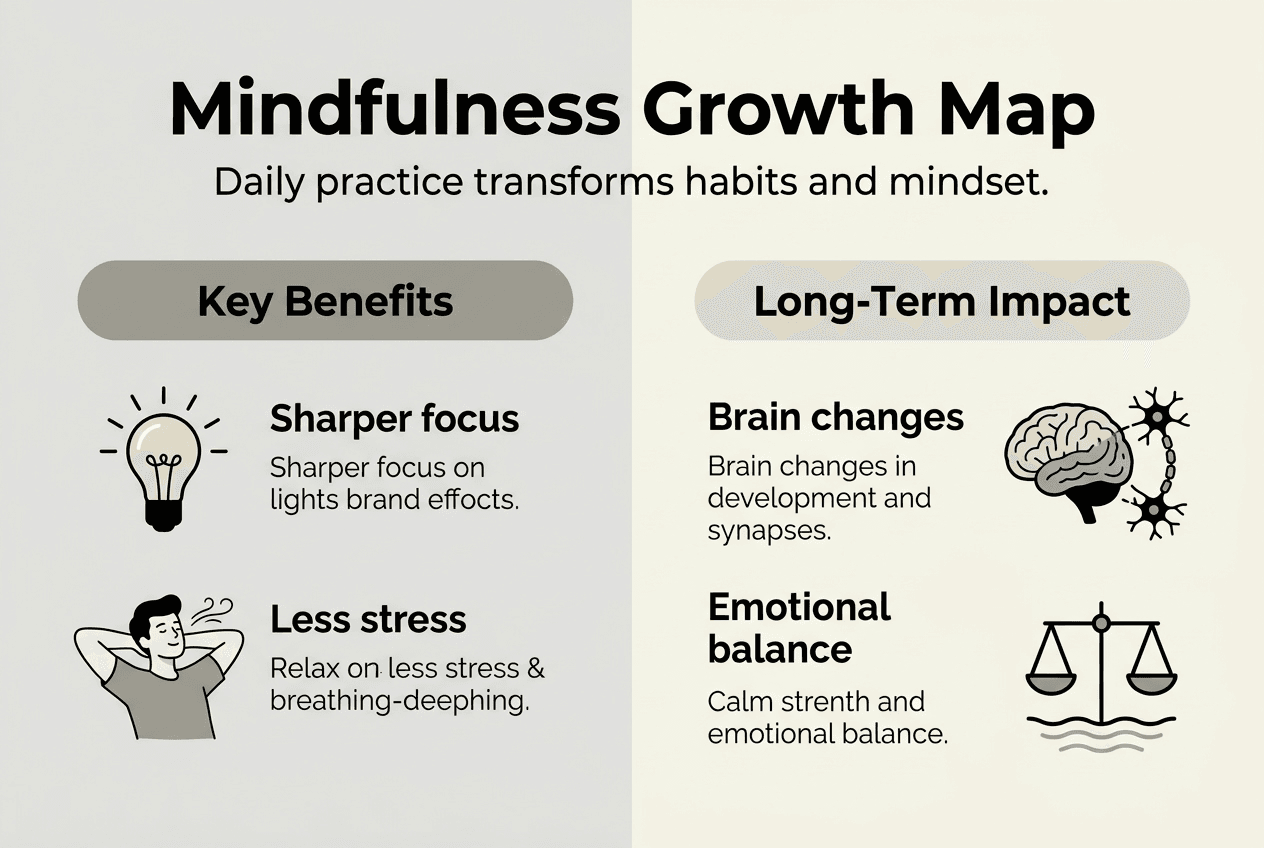
Research demonstrates tangible brain changes from consistent practice. Studies show increased gray matter density in the prefrontal cortex, which governs decision-making and self-control, and the hippocampus, responsible for memory and emotional processing. Regular mindfulness also decreases cortisol levels, the primary stress hormone that triggers your fight-or-flight response. Buddhist meditation, including Samatha and Vipassana, cultivates emotional regulation by strengthening neural pathways that support calm awareness under pressure.
The documented benefits extend across mental, emotional, and physical domains:
Improved concentration and sustained attention span
Reduced anxiety and stress responses
Enhanced emotional stability and resilience
Greater self-awareness and introspective clarity
Better sleep quality and physical relaxation
Increased compassion toward yourself and others
These advantages accumulate over time, creating a foundation for personal growth that touches every aspect of your life. You develop the capacity to observe your inner experience without getting swept away by reactive patterns. This meta-awareness becomes a powerful tool for navigating challenges, making intentional choices, and aligning your actions with your deeper values.
Preparing for your daily mindfulness practice
Starting a mindfulness routine requires the right mental approach and physical setup. Adopt a curious, nonjudgmental mindset that treats practice as exploration rather than performance. You will encounter resistance, distraction, and frustration, especially early on. These experiences are normal parts of the learning process, not signs of failure. Beginners often struggle with ‘monkey mind’, the restless mental chatter that jumps between thoughts, and success comes from gentle redirection rather than harsh self-criticism.
Your environment shapes practice quality significantly. Choose a quiet space where interruptions are minimal, whether a corner of your bedroom, a comfortable chair, or a cushion on the floor. Consistency in location helps your brain associate that space with calm focus. Select a regular time that fits your schedule, such as early morning before daily demands arise or evening after work winds down. Physical comfort matters, so sit in a position you can maintain without pain, whether cross-legged, kneeling, or in a chair with feet flat.
Basic tools support your practice without adding complexity:
A timer or meditation app to track session length
A cushion or chair for comfortable seated posture
Optional calming background sounds or silence
A journal for post-practice reflection
Expect your mind to wander constantly at first. This ‘monkey mind’ phenomenon reflects normal brain activity, not personal inadequacy. When you notice thoughts drifting to plans, worries, or daydreams, acknowledge them without judgment and return your attention to your chosen anchor, typically the breath. This cycle of noticing and redirecting is the practice itself, not a distraction from it. Building this meditation routine guide creates a sustainable foundation.
Pro Tip: Begin with five-minute sessions to establish the habit before extending duration. Short, consistent practice builds neural pathways more effectively than sporadic long sessions that feel overwhelming.
Executing your mindfulness practice step by step
Follow this structured approach to conduct effective daily mindfulness sessions. Each step builds on the previous one, creating a complete practice cycle that strengthens awareness and calm.
Find your seated position with spine upright but not rigid, hands resting comfortably on your lap or knees.
Close your eyes or maintain a soft downward gaze to minimize visual distractions.
Take three deep breaths to signal the transition from activity to practice.
Shift attention to your natural breath without controlling its rhythm or depth.
Notice the physical sensations of breathing: air entering nostrils, chest rising, belly expanding.
When thoughts arise, observe them without engagement, then gently return focus to breath.
Continue this cycle of attention, distraction, and redirection for your chosen duration.
End by taking three intentional breaths and slowly opening your eyes.
Spend a moment noticing how you feel before resuming activities.
The quality of attention matters more than the absence of thoughts. Mindfulness practice, even short durations, reduces stress by training your brain to recognize when attention has wandered and consciously redirect it. This meta-awareness transfers to daily life, helping you catch reactive patterns before they escalate.

Session Length | Primary Benefits | Typical Results Timeline |
5-10 minutes | Habit formation, initial stress relief | 2-3 weeks |
15-20 minutes | Improved focus, emotional regulation | 4-6 weeks |
30+ minutes | Deep relaxation, significant brain changes | 8-12 weeks |
Integrate mindfulness into everyday activities to extend practice beyond formal sessions. Pay full attention while eating, noticing flavors, textures, and the act of chewing. Walk mindfully by feeling each foot contact the ground and observing your surroundings without mental commentary. These mindfulness meditation benefits compound when you weave awareness throughout your day.
Pro Tip: Anchor practice to an existing habit like morning coffee or evening tooth brushing. This habit stacking technique leverages established routines to support new behaviors.
Troubleshooting common challenges and sustaining your practice
Every practitioner encounters obstacles that threaten consistency. Mind wandering remains the most frequent challenge, with attention drifting to plans, memories, or worries within seconds of settling into practice. Frustration builds when you expect immediate calm but experience mental chaos instead. Missing sessions creates guilt that can derail motivation entirely. These patterns are universal experiences, not personal failures.
Challenge | Reactive Response | Proactive Solution |
Mind wandering constantly | Judge yourself as bad at meditation | Treat each redirection as successful practice |
Feeling frustrated or bored | Force yourself to sit longer | Shorten sessions and focus on quality |
Missing scheduled sessions | Abandon practice altogether | Resume immediately without self-criticism |
Expecting instant calm | Feel discouraged and quit | Recognize benefits accumulate gradually |
Self-compassion provides the foundation for sustainable practice. When you notice harsh inner criticism, apply the same kindness you would offer a friend learning a new skill. Acknowledge difficulty without dramatizing it, then return to your anchor with fresh intention. This gentle approach prevents the shame spirals that undermine long-term commitment.
Practical strategies support consistency through inevitable rough patches:
Set phone reminders for your designated practice time
Track sessions in a journal to visualize progress
Start with micro-goals like three sessions per week
Join online communities for accountability and encouragement
Celebrate small wins rather than fixating on perfection
Sustained practice creates measurable changes in brain structure and function. Mindfulness practice reshapes brain networks influencing emotional regulation and self-awareness, strengthening connections between the prefrontal cortex and limbic system. These neurological adaptations enhance your capacity to observe emotions without being controlled by them. The cumulative effect transforms how you respond to stress, make decisions, and relate to yourself and others.
Long-term practitioners report that mindfulness becomes less about formal sitting and more about a pervasive quality of presence. You catch yourself reacting and choose a different response. You notice beauty in ordinary moments. You access calm even amid chaos. This practicing self-awareness evolves from deliberate effort into natural orientation, fundamentally shifting your relationship with experience.
Explore flow mastery for deeper mindfulness
Ready to accelerate your mindfulness journey beyond daily practice basics? Awaken Flow Mastery offers specialized programs designed to help you access sustained flow states and align with your highest potential. Our flow mastery meditation combines guided audio sessions with energy work techniques developed over a decade of practice.

The awaken flow mastery challenge provides 30 days of structured meditation paired with intuitive journaling and integration practices. You’ll learn to connect with your energetic field naturally, embedding insights into daily life for lasting transformation. Explore the reconnect higher self meditation to deepen self-awareness and unlock clarity that supports personal growth at every level.
FAQ
What if my mind keeps wandering during mindfulness practice?
Mind wandering is completely natural and expected, especially for beginners. The practice is not about eliminating thoughts but noticing when attention drifts and gently guiding it back to your breath or chosen anchor. Each time you redirect your focus, you strengthen the neural pathways that support concentration and self-awareness. Managing ‘monkey mind’ becomes easier with consistent practice, transforming frustration into patient observation.
How long should my daily mindfulness sessions be?
Start with five to ten minutes and gradually increase duration as the habit solidifies. Consistency matters far more than length, so brief daily sessions outperform sporadic long meditations. Many practitioners find 15 to 20 minutes ideal for balancing depth with sustainability. Listen to your body and schedule, adjusting as needed while prioritizing regular practice over ambitious goals that become overwhelming.
Can mindfulness practice help reduce stress quickly?
Research shows mindfulness meditation reduces cortisol levels and improves emotional regulation within weeks of regular practice. Most studies document significant stress reduction after eight weeks of consistent sessions. You may notice subtle shifts in reactivity and calm sooner, but substantial benefits accumulate gradually. The practice rewires your stress response system, creating lasting changes rather than temporary relief.
How can I integrate mindfulness into everyday activities?
Bring full sensory attention to routine tasks like eating, walking, washing dishes, or commuting. Notice textures, temperatures, sounds, and physical sensations without mental commentary or judgment. This informal practice extends awareness beyond formal sitting sessions, deepening your overall mindfulness capacity. Explore mindfulness meditation routines that blend structured and informal approaches for comprehensive integration into daily life.
Recommended

Comments