
Clarity Through Meditation: Enhancing Self-Awareness
Feeling stuck in a whirlwind of thoughts and emotions is a common struggle for spiritual seekers navigating modern life. The need for clarity goes beyond quieting anxiety—it is about experiencing true, present-centered awareness that transforms how you relate to yourself and others. Guided meditation practices offer scientifically proven pathways to heightened self-awareness and emotional balance, giving your mind a break from mental clutter and opening the door to authentic insight and calm.
Table of Contents
Key Takeaways
Point | Details |
Clarity Through Meditation | Clarity is achieved through present-centered awareness and reduces mental clutter, enhancing focus and emotional regulation. |
Consistent Practice Matters | Practicing meditation daily for shorter periods produces more significant neurological changes than longer, less frequent sessions. |
Understanding Your Mind | Meditation cultivates self-awareness by allowing you to recognize thoughts, emotions, and patterns without judgment. |
Integration Into Daily Life | Applying insights from meditation in everyday situations transforms clarity into genuine relationships and decision-making. |
Defining Clarity Through Meditation Practices
Clarity through meditation isn’t vague or mystical. It’s a measurable shift in how your mind processes information and responds to life’s demands.
When you meditate, you’re engaging contemplative techniques regulating body and mind to cultivate heightened awareness. This isn’t just feeling calmer—your brain undergoes real neurological changes that support sustained mental focus and reduced mental noise.
What Clarity Actually Means in Meditation
Clarity is focused awareness without the constant chatter. It’s the difference between scrolling through 50 browser tabs mentally and having one clear window open.
Within meditation practice, clarity emerges as:
Present-centered awareness without judgment or resistance to what arises
Reduced mental clutter allowing you to see situations clearly without distortion
Improved emotional regulation so reactions become responses
Enhanced attentional control focused where you choose, not where anxiety pulls you
This doesn’t mean silence or blank thoughts. It means your mind stops fighting itself.
How Your Brain Changes With Regular Practice
Mindfulness meditation enhances sustained attention and emotional regulation through ongoing practice. Research shows that regular meditators experience decreased baseline neural complexity—your brain literally reorganizes to default into clearer states.
During actual meditation sessions, neural complexity increases, meaning your brain is highly active and organized. Over time, this becomes your new baseline. You don’t need to sit formally to access this clarity.
The Connection to Self-Awareness
Clarity and self-awareness are inseparable. When mental noise quiets, you notice patterns you couldn’t see before.
You recognize:
How fear shapes your decisions
Where you abandon yourself in relationships
Which thoughts are truly yours versus inherited beliefs
Your body’s signals before they become crises
This isn’t introspection spiraling. This is clear observation of what’s actually happening inside you.
Why Consistency Matters More Than Duration
Ten minutes daily creates more neurological change than ninety minutes once weekly. Your brain responds to consistent signals, not occasional marathons.
The practice gradually stabilizes clarity as your natural state. You stop needing to “get into” meditation and start living from that clarity.
Clarity emerges not from forcing stillness, but from the steady practice of returning your attention again and again to the present moment.
Pro tip: Start with five minutes daily at the same time each morning to anchor the practice into your nervous system, allowing clarity to become your default rather than an occasional achievement.
Major Meditation Styles for Gaining Clarity
Not all meditation feels the same, and that’s intentional. Different styles engage your brain in distinct ways, each offering a unique path to clarity.
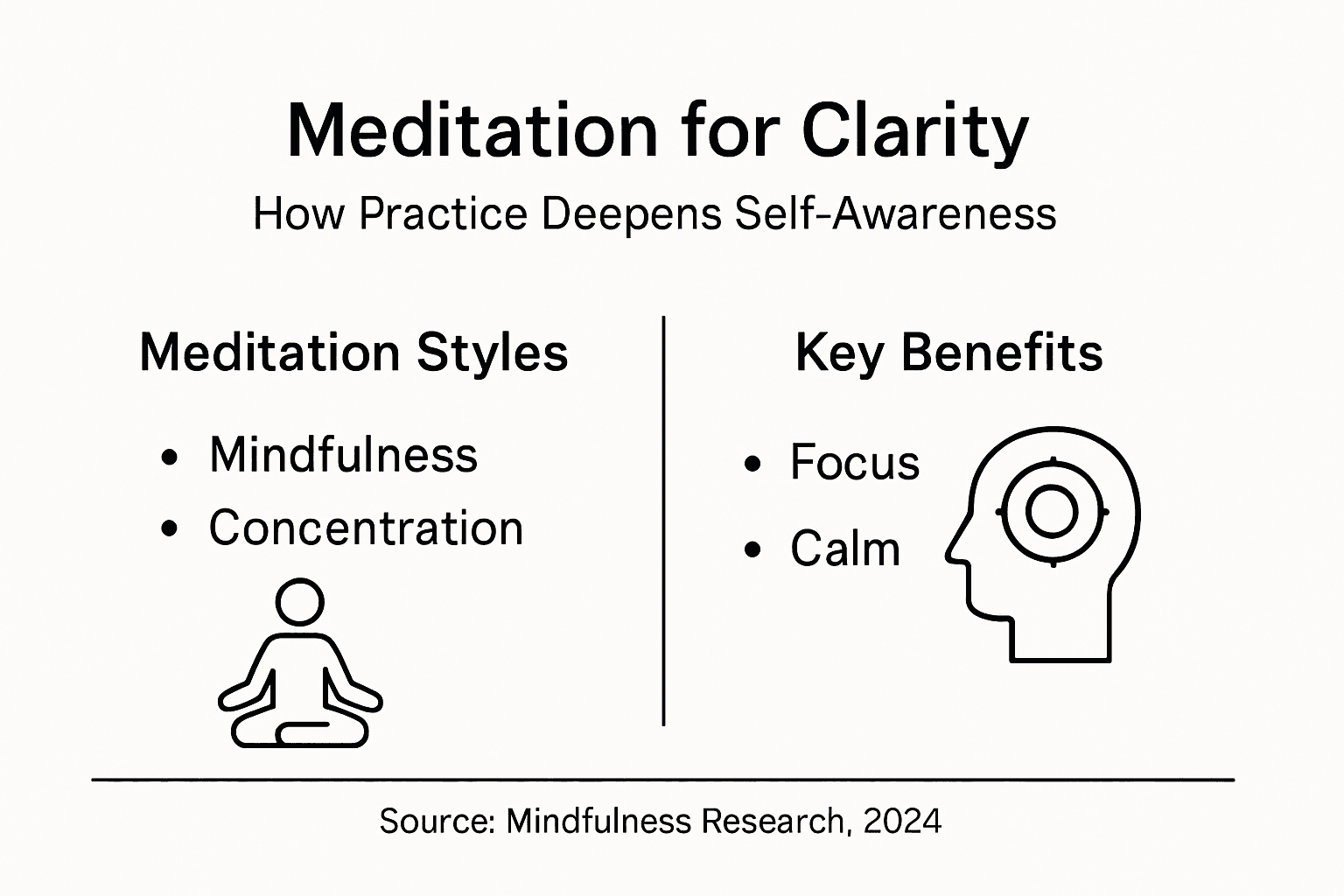
Contemplative practices vary widely with distinct styles such as mindfulness, concentration, and insight meditation. Each cultivates clarity through different mechanisms, ensuring diverse pathways work for different minds.
Here’s a summary of how major meditation styles influence clarity and self-awareness:
Meditation Style | Main Approach | Impact on Clarity | Best Suited For |
Mindfulness | Open, present observation | Reduces mental noise | Those feeling overwhelmed |
Concentration | Single-pointed focus | Sharpens attention | Analytical thinkers |
Insight (Vipassana) | Deep body/mind exploration | Reveals patterns | Seekers of self-knowledge |
Transcendental | Mantra repetition, effortless | Promotes quiet awareness | Anxious individuals |
Mindfulness Meditation: The Open-Awareness Approach
Mindfulness emphasizes present-focused awareness without trying to change what arises. You notice thoughts, sensations, and emotions as they happen, then let them pass without judgment.
This style works by:
Training your attention to stay present rather than chase thoughts
Creating distance between you and reactive patterns
Building emotional regulation through observation, not control
Allowing clarity to emerge naturally as mental chatter quiets
Mindfulness suits people who feel overwhelmed by constant thinking. The permission to observe without fixing creates immediate relief.
Concentration Meditation: Focused Attention
Concentration meditation develops laser-focused attention by anchoring your mind to one object: your breath, a mantra, or a visual point.
Your attention wanders. You notice. You gently return. That cycle strengthens neural pathways supporting sustained focus and mental discipline.
This style clarifies by removing scattered energy. When your mind isn’t pulled in fifty directions, what remains becomes crystal clear.

Insight Meditation: Understanding Your Inner World
Insight meditation, or Vipassana, works towards self-awareness and experiential understanding. You observe mental and physical sensations with penetrating attention, developing direct insight into how your mind actually works.
You might notice:
How fear manifests in your body before conscious thought
Patterns repeating across relationships and decisions
The impermanent nature of emotions and thoughts
Your authentic preferences versus inherited conditioning
This clarity comes from seeing, not from thinking about what you see.
Transcendental Meditation: Sound-Based Centering
Transcendental meditation uses a personalized mantra to settle your mind into deeper states. Unlike concentration meditation, you don’t focus on the mantra—you use it as a vehicle to transcend surface thinking.
Transcendental meditation and focused attention produce varying neurobiological changes that enhance attention and emotional regulation. Many report accessing clarity through profound mental quietness.
Choosing Your Style
Your ideal practice matches your temperament and what your nervous system needs right now.
Analytical minds: Concentration or insight meditation
Anxious systems: Mindfulness or transcendental meditation
Seeking direct experience: Insight meditation
Wanting simplicity: Concentration meditation
The right meditation style isn’t the most popular one—it’s the one you’ll actually practice consistently.
Pro tip: Try each style for one week before deciding; your nervous system will tell you which one creates lasting calm and clarity rather than feeling forced.
How Meditation Enhances Self-Awareness
Self-awareness isn’t something you think your way into. It emerges when your mind quiets enough to actually observe what’s happening inside you without judgment.
Meditation creates the conditions for this observation. As you practice, your brain physically changes in ways that deepen your understanding of yourself.
The Neuroscience of Self-Awareness Through Meditation
Meditation enhances self-awareness by modifying brain regions involved in emotion regulation, attention, and sensory processing. Your amygdala—the alarm system that triggers fear and reactivity—actually shrinks with consistent practice.
Simultaneously, neuroplasticity induced by meditation increases cortical thickness in regions supporting self-reflection. Your brain literally rewires itself to default into awareness rather than autopilot.
This means:
You notice emotions arising before they hijack your behavior
Bodily sensations become clearer—tension, ease, subtle shifts
Thought patterns become visible instead of invisible
Reactive triggers lose their automatic power
From Reaction to Reflection
Most people live in reaction mode. Something happens, your nervous system responds, and your thoughts follow—all before consciousness catches up.
Meditation reverses this. Meditation cultivates deep self-awareness by enabling practitioners to access transcendent states where you shift from reactive mental patterns to reflective observation.
You step back and watch your mind work. Fear appears. You observe it. It passes. You’re no longer trapped inside the emotion—you’re witnessing it.
Recognizing Your True Patterns
As self-awareness deepens, recurring patterns become impossible to ignore. You notice:
How you abandon yourself in relationships, then feel resentful
The exact moment anxiety shifts from thought to physical tension
Which beliefs actually serve you versus those inherited from family
Your body’s early warning signals before exhaustion or crisis
Authentic desires beneath layers of “should”
This isn’t intellectual understanding. It’s direct seeing.
The Cascade Effect on Your Life
Heightened self-awareness creates a cascade. When you see a pattern clearly, you can’t unsee it.
That awareness creates choice. Before, automatic reactions controlled your decisions. Now you can pause and respond differently. This is where real change begins.
Self-awareness without judgment is the foundation of transformation—meditation teaches you how to observe yourself with compassion instead of criticism.
Pro tip: Keep a simple journal after meditation, noting one emotional or physical pattern you noticed; over weeks, recurring themes reveal your deepest growth edges.
Integrating Meditation Insights Into Daily Life
The real transformation happens off the cushion. Insights from meditation practice mean nothing if they disappear the moment you stand up.
Integration is the bridge between clarity you feel during practice and clarity you live in relationships, work, and decisions.
From Formal Practice to Everyday Awareness
Applying meditation insights into daily life requires translating cultivated states of clarity and self-awareness into behaviors, decision-making, and social interactions. The goal isn’t perfection—it’s consistency.
You carry the observational awareness you build during meditation into ordinary moments. You notice tension rising. You pause before speaking. You recognize a familiar fear pattern activating.
That’s integration.
Mindful Listening: Where Others Feel Heard
Mindful listening extends meditation directly into relationships. Instead of planning your response while someone talks, you actually listen. You hear the emotion beneath their words.
This transforms:
Conversations from debates into genuine connection
Conflicts from battles into opportunities for understanding
Relationships from surface-level to authentic
Others from problems to be fixed into people to be understood
One person feeling truly heard changes everything.
Mindful Eating and Sensory Awareness
Mindful eating isn’t about restriction. It’s about actually tasting food instead of eating on autopilot while scrolling or working.
You slow down. You notice flavors, textures, satisfaction signals. Your body tells you when it’s full. You stop eating when the mind-body connection is active instead of when the plate is empty.
This small practice ripples outward—you become more aware in other sensory experiences too.
Creating Anchor Points Throughout Your Day
Integration works best with small, strategic practices scattered through your day.
Choose moments to pause:
Before checking your phone in the morning
When walking between meetings
While waiting in line
Before eating
When stress first appears
Before bed
During these pauses, drop into the same awareness you cultivate during formal meditation. Notice breath, body, sensations, thoughts.
To help you integrate clarity from meditation into daily life, here’s a reference guide for practical anchor points:
Daily Anchor Point | Integration Practice | Benefit Received |
Morning routine | Pause for 2 deep breaths | Sets calm for the day |
Walking between meetings | Check in with your body | Reduces accumulated stress |
Waiting in line | Observe surroundings mindfully | Enhances patience and presence |
Before meals | Practice mindful eating | Boosts body-mind connection |
The Consistency Principle
One mindful moment daily won’t rewire your nervous system. But consistent small practices accumulate.
Your brain reorganizes around what you repeatedly practice. Daily pauses create neural pathways supporting sustained awareness, emotional regulation, and stress management across all situations.
Integration isn’t about doing meditation perfectly everywhere—it’s about bringing one moment of genuine awareness into your day, then building from there.
Pro tip: Set three specific daily anchor points (e.g., morning coffee, lunch, evening walk) where you pause for two conscious breaths; this consistency builds integration faster than sporadic awareness.
Mistakes to Avoid for Lasting Mental Clarity
Most people quit meditation not because it doesn’t work, but because they approach it wrong. Understanding common pitfalls saves months of frustration and prevents losing gains you’ve already made.
Unrealistic Expectations Sabotage Your Practice
The biggest mistake: expecting instant transformation. You won’t sit down and suddenly achieve permanent bliss or perfect clarity.
Clarity develops gradually through consistent practice. Effective meditation practice for lasting mental clarity requires avoiding unrealistic expectations and inconsistent effort that leads to burnout.
Instead, expect:
First two weeks: adjusting to stillness, noticing how restless your mind actually is
Weeks three to eight: moments of clarity appearing, then disappearing
Months two to three: clarity becoming more stable and accessible
Beyond three months: genuine shifts in how you respond to life
This timeline varies. Patience isn’t optional.
Inconsistent Practice Erases Your Progress
Meditation isn’t like taking a vitamin. Missing days breaks the chain of neurological rewiring your brain needs.
Your nervous system responds to signals. When you meditate sporadically, you send conflicting signals. The benefits plateau or disappear entirely.
One practice per week won’t create lasting change. Five minutes daily will.
Ignoring Emotional Challenges as They Arise
Deeper meditation can surface suppressed emotions, memories, or uncomfortable sensations. Many people interpret this as meditation “not working” and quit.
Instead, this is meditation working. You’re becoming aware of what was already there, buried beneath the noise.
Research emphasizes accepting difficulties as part of the meditative journey with patience and non-judgment. When difficult emotions surface, that’s the clarification process happening.
Forcing Effort Leads to Burnout
Meditation isn’t about willpower or intensity. Grinding through 60-minute sessions when you hate meditation doesn’t build clarity—it builds resistance.
Balanced effort means:
Practicing duration that feels sustainable, not punishing
Resting when you need rest, not pushing through exhaustion
Adjusting your technique when something isn’t working
Accepting that some days clarity flows easily and others feel cloudy
Practicing Without Guidance Creates Blind Spots
Trying to navigate meditation entirely alone means you can’t see your own patterns, resistance, or misconceptions.
Structured training with ongoing support prevents wasted effort and helps you progress faster. A guide notices what you can’t see about yourself.
Neglecting Your Body’s Signals
Ignoring physical discomfort, fatigue, or stress signals during meditation damages clarity instead of building it.
Your body communicates constantly. When meditation practice ignores those signals, you’re fighting against your own nervous system rather than working with it.
Lasting mental clarity comes from meeting your practice with consistency, patience, and gentleness—not from willpower or intensity.
Pro tip: Start with five minutes daily for two weeks before adjusting duration; this prevents burnout while establishing the neural consistency clarity requires.
Unlock Lasting Clarity and Deep Self-Awareness with Guided Meditation
Struggling to maintain mental clarity and truly understand your emotional patterns can feel overwhelming. This article highlights common challenges like scattered attention, emotional reactivity, and inconsistent meditation practice that block you from sustaining clarity and self-awareness. If you find that your mind often feels cluttered or reactive, and you want to embrace the steady, clear presence described here, then a structured yet gentle approach is key.
At Awaken Flow Mastery, we provide a comprehensive 30-day guided meditation and energy alignment program designed to help you access and sustain flow states effortlessly. Our program integrates intuitive journaling, sound frequencies, and proven integration practices rooted in over a decade of expertise. This not only enhances your concentration and emotional regulation but also bridges meditative insights directly into everyday life.
Explore how our guided meditation series supports sustained clarity and empowers you to consistently return your attention to the present moment with ease. Join a community committed to healing, personal growth, and spiritual awakening. Experience clarity as your natural state, not a fleeting achievement.
Start your journey now and transform meditation from a sporadic effort into a life-changing practice that deepens self-awareness and emotional resilience.
Frequently Asked Questions
What is clarity in meditation?
Clarity in meditation refers to focused awareness without the mental chatter. It’s about seeing situations clearly, reducing mental noise, and improving emotional regulation.
How does meditation change the brain?
Regular meditation alters brain function by decreasing baseline neural complexity and increasing attention and emotional regulation, leading to clearer thinking and focus over time.
Why is consistency important in meditation practice?
Consistency is crucial because daily practice creates lasting neurological changes more effectively than irregular, longer sessions. It stabilizes clarity as your natural state rather than an occasional achievement.
What are different styles of meditation for gaining clarity?
Major meditation styles for gaining clarity include mindfulness, which promotes present-centered awareness; concentration meditation, which sharpens attention; insight meditation (Vipassana), which reveals personal patterns; and transcendental meditation, which uses mantras for quiet awareness.
Recommended

Comments